
Sturgis City Commission holds first reading of recycling ordinance
The commission will hold a second reading of the ordinance at its next regular meeting on Wednesday, November 12, again seeking public input. After the second reading, there is a 20-day waiting period before the ordinance could take effect.

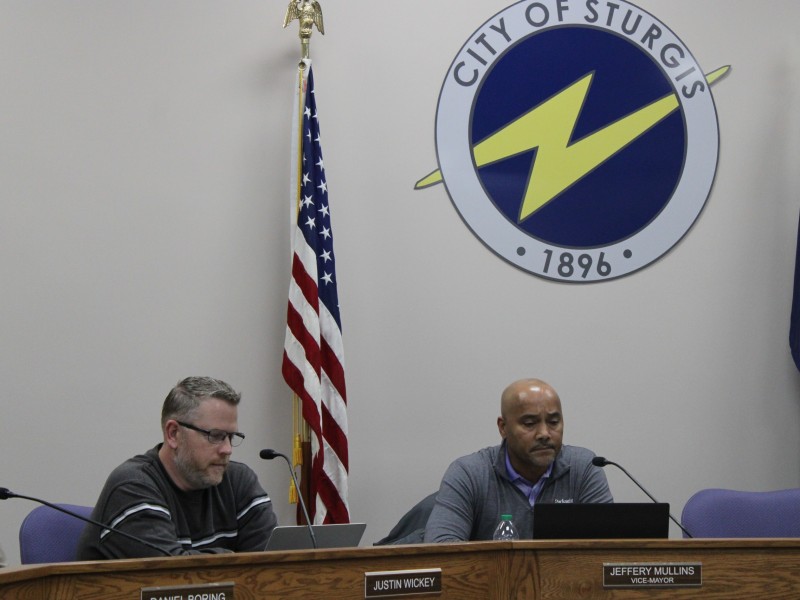
The Sturgis City Commission held the first reading of its proposed recycling ordinance during its Wednesday, October 22 meeting, viewing it as an opportunity to gather public feedback on the proposal rather than place it on a future ballot.
Only one member of the public spoke — Jamie Crites, a landlord who said he was attending for another reason.
“We control 300 houses, so that ought to be 300 votes. We don’t want it,” Crites said.
Commissioners continued discussing their divided views on the issue.
Commissioner Marvin Smith opposed the measure, arguing that Borden Waste Management holds a monopoly on trash and recycling services in Sturgis. Smith questioned whether another company might step in if the city ends its contract with Borden.
“How do we know they won’t? It’s supply and demand,” Smith said. “I would just like to reiterate that this is a bad idea. I shouldn’t have to pay for anything for my neighbor.”
Smith urged the commission to consider landlords’ perspectives, comparing them to small businesses.
Commissioners Kathy Abbs and Dan Boring countered, asking, “How do we know they will?” They noted the city is in an all-or-nothing position: if recycling is discontinued, Borden could pull all services, and it’s unclear whether another hauler would serve Sturgis.
“As we’ve talked about before, we’re in an all-or-nothing situation,” Commissioner Linda Harrington added.
Commissioners asked City Attorney T.J. Reed who would be penalized for repeated misuse of recycling bins if the ordinance passes. Reed said citations would go to the violator — even in multi-unit buildings.
“Whoever’s violating the ordinance [gets the ticket],” Reed said.
Abbs said that while not everyone supports making recycling a utility service, rising costs are unavoidable.
“Everyone’s going to pay more — it’s a matter of if it’s the trash or recycling,” Abbs said. “If you don’t have recycling, I can promise you your garbage is going up.”
Abbs cited conversations with residents who use private haulers and expect prices to rise regardless. Commissioners Aaron Miller and Boring agreed.
Abbs motioned to approve the first reading, with Harrington seconding.
The motion passed 7–2, with Harrington, Abbs, Boring, Wickey, Bir, Miller, and Mullins in favor, and Mayor Frank Perez and Smith opposed.
The commission will hold a second reading of the ordinance at its next regular meeting on Wednesday, November 12, again seeking public input. After the second reading, there is a 20-day waiting period before the ordinance could take effect.
What’s in the ordinance?
An ordinance is a local law adopted by a city commission or council. It carries the force of law within city limits, unlike a resolution, which typically expresses policy or intent. Most ordinances require two readings before adoption, allowing time for public comment and revisions.
The proposed recycling ordinance would make curbside recycling a mandatory city utility service, billed through residents’ utility accounts. Participation would no longer be optional for eligible properties, and the cost is expected to range from $6 to $8 per month (about $72 to $96 annually).
According to City Manager Andrew Kuk, the updated draft includes several changes since the September discussion:
- Downtown exemption: Buildings with residential units located only above the ground floor would be excluded.
- Billing method: Fees would be charged to property owners, not tenants; nonpayment could result in a lien on the property.
- Enforcement: City staff could issue penalties for repeated or serious violations, such as mixing trash with recyclables, while minor issues could be handled at their discretion.
- Renewal timeline: The ordinance would automatically expire on December 31 of its first year unless renewed, then follow an annual review aligned with the city’s budget cycle.
If adopted after the second reading and waiting period, recycling would appear as a utility fee rather than a voluntary service, with Borden Waste Management continuing as the city’s contractor.
Other business
The commission approved raising election-worker pay to $14 an hour for inspectors and $15.50 for chairpersons, keeping the city competitive amid rising wages for election staff across Michigan.
Commissioners also approved a change to the city’s stop-loss health-insurance coverage, raising the per-claim threshold from $65,000 to $100,000 to offset premium increases. Staff said the change could save the city more than $300,000 annually, though it increases per-claim risk.
City staff also recognized longtime employee Holly Keyser for her years of service and dedication to the city. Keyser’s husband spoke during the meeting, sharing stories of her behind-the-scenes work and congratulating her on a well-earned retirement. Sadie Griffin, who has been training under Keyser, will assume the role of City Controller full-time.
Maxwell Knauer is a staff writer for Watershed Voice.
Editors note: This article has been updated to correctly identify that Holly Keyser, City Controller, is retiring. The update was made at 9:12 a.m. on Friday, October 24.
Author

Related Articles

Sturgis City Commission finalizes recycling contract, approves fire truck purchase amid heated public comment on homelessness
A local laundromat owner, Alvie Wall, told commissioners he has dealt with repeated vandalism and theft and said he feels the city has failed to address the issue.
“I know you’re sympathetic to the homeless. You feel bad because they’re homeless,” Wall said. “They choose to be homeless. Big deal. That’s their deal. Be homeless all you want, but stop vandalizing my stuff.”

Local meeting primer: Sturgis City Commission to finalize recycling contract, consider marijuana ordinance changes, and fire truck purchase
Commissioners are expected to finalize a months-long debate over whether to continue curbside recycling in the city. During the meeting, the commission will consider approval of an exclusive franchise agreement with Borden Waste-Away Service LLC, the city’s current recycling provider.
Sturgis approves utility upgrades, vehicle fleet changes, and holiday tree pickup fundraiser
To start off new business, commissioners unanimously approved a fundraiser in partnership with Gest Pro Tree Services and United Way. For a minimum $25 donation to United Way, Gest Pro Tree Services will pick up Christmas trees from a participating resident’s curbside, chip the tree, and compost the chippings. Donations must be made in advance, and the deadline to sign up is January 4.
