
Three Rivers residents recount moments before and after Friday’s EF-2 tornado
The storm was among the fiercest to strike Three Rivers in recent memory. Despite the destruction, residents across the city rushed to support one another before, during, and after.
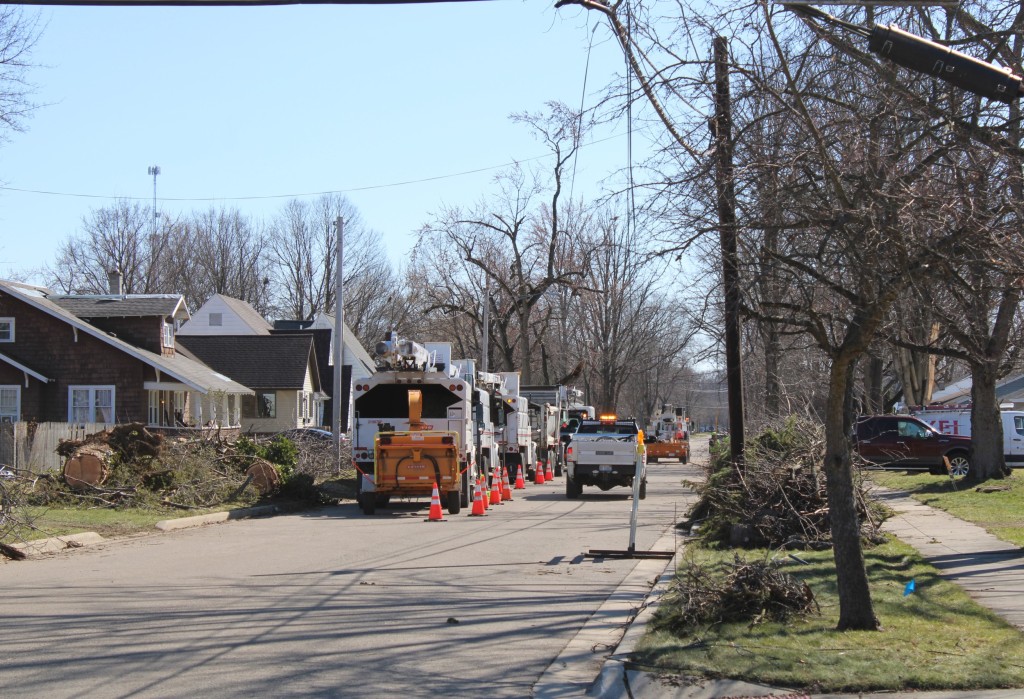
On Friday, March 6, a tornado struck the city of Three Rivers just before 4 p.m. The tornado was rated an EF-2, with estimated wind speeds up to 130 mph, according to the National Weather Service.
The storm was among the fiercest to strike Three Rivers in recent memory. Despite the destruction, residents across the city rushed to support one another before, during, and after.
Early reports of the tornado began circulating on Facebook after a large section of Menards roof was ripped away and seen flying through the air. Around 10 minutes earlier, tornado sirens had begun sounding across the city.
The warning sirens sounded when the city was initially issued a tornado warning by the National Weather Service. The sirens sounded for several minutes and then stopped. In most parts of the city, the weather remained sunny and in the mid-60s.
Mayor Angel Johnston told Watershed Voice she messaged City Manager Joe Bippus asking why the sirens had not sounded again after the initial warning.
“It was a beautiful day, and I didn’t even think twice about it. I had the Storm Chasers on anyway, but I’m just so shocked that they did not turn the sirens back on when we knew we had a tornado on the ground,” Mayor Johnston said.
Johnston said the city changed its tornado siren policy after a windstorm last year damaged the sirens when they sounded for an extended period.
“They only sound the alarm when the warning itself is issued,” Johnston said. “This time the sirens went off for a couple of minutes and that was it. The reasoning, I was told, was that last year during a windstorm the sirens ran for nearly 40 minutes and burned out. That was obviously overkill too — I remember being extra terrified and calling work, but when it’s 70 degrees and sunny, if people aren’t paying attention to the TV, that siren might make them check their phone or turn on the news. When it only sounds for a couple of minutes and then stops, it almost feels like a false alarm — or even like an all-clear.”
Despite the confusion, many residents found out about the storm by simply looking outside their window and seeing the tornado itself.
Beth Everett, a Three Rivers resident who lives on South Constantine Street — one of the areas hardest hit by the storm — told Watershed Voice her husband briefly went upstairs during the storm because his back was hurting from sitting in their basement. Everett’s husband looked out a side door and saw the tornado in the distance.
“When the tornado alarm went off, the sky was clear. We were sitting on the porch and there wasn’t a cloud in the sky,” Everett said. “I called my daughter-in-law and asked if there were any storm warnings. She said they do the sirens the first Friday of every month. Then our phones went off with the tornado warning, so we went to the basement just to be safe.”
Editor’s note: The City of Three Rivers tests their siren the first Saturday of each month, which would have been March 7, the day after the tornado touched down in the city.
“With his [Everett’s husband] bad back he said he couldn’t handle sitting down there anymore,” she said. “He came upstairs to sit down and got to the top of the steps where there’s a side door. He happened to look out and saw the tornado, then ran back down to the basement. He said, ‘There is a tornado.’ I told him, ‘No way.’ He said, ‘Yeah.’ So I called my daughter-in-law, who lives a few blocks down, and told her to stay in the basement.”
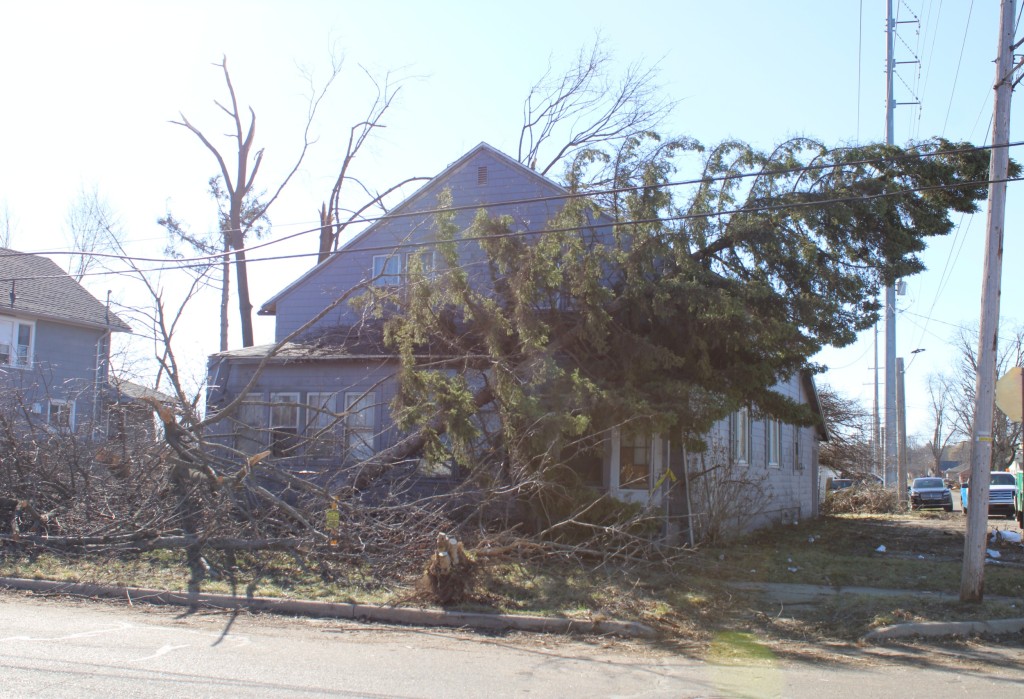
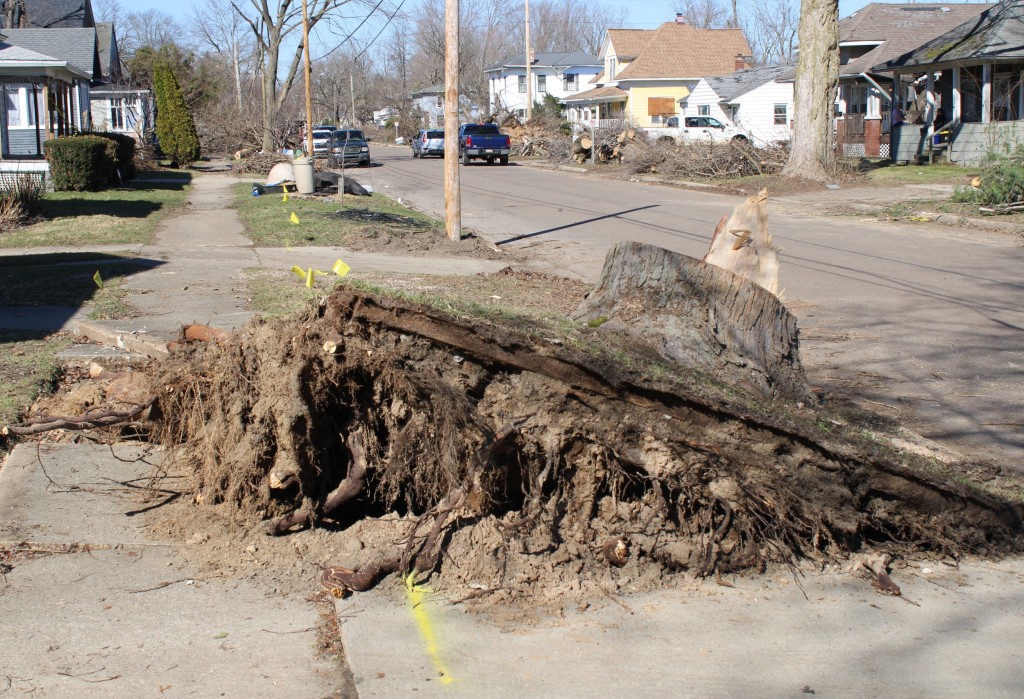
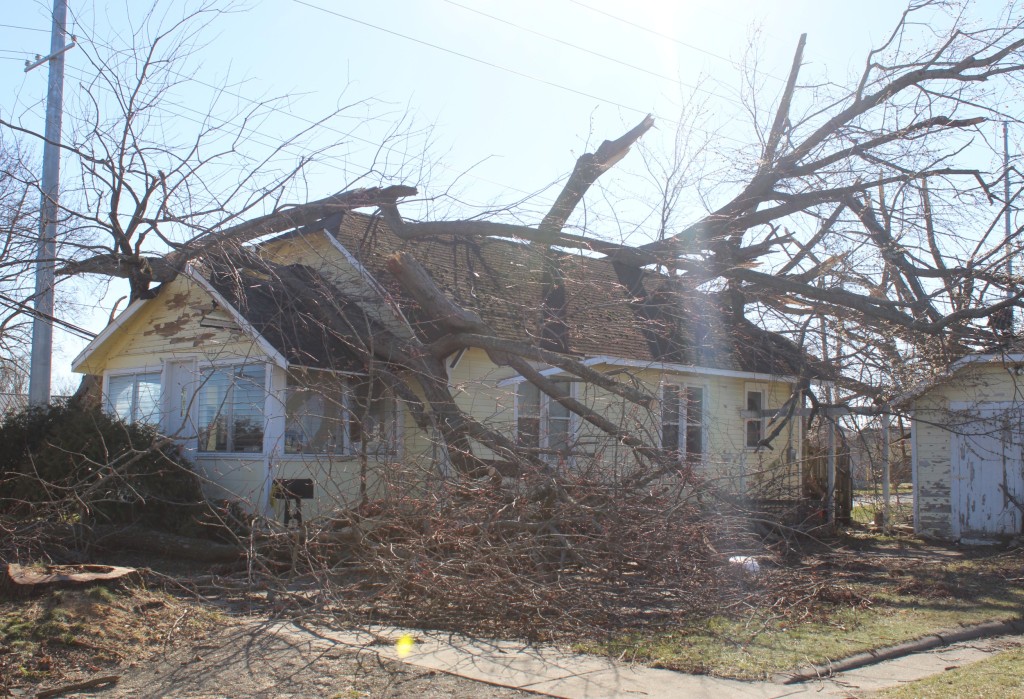
Soon after Everett’s husband made it back downstairs, the roughly 30-foot maple tree in their front yard slammed into the street, shaking their house and shattering a second-story window in their neighbor’s home.
“When the tree went down, the whole house shook. It just went straight across the street and it actually took out that upstairs window in the neighbor’s house. It was a huge maple.”
Once the storm cleared, Everett and her husband went to check the damage. Their house, unlike most on South Constantine, had been lightly damaged with the worst being a tree leaning from their yard onto their roof. Everett and her husband checked the pantry and accepted that they might have to ration a bag of Doritos for dinner.
“We were lucky. Friday night we had a bag of Doritos in the house, and I was pretty sure that was going to be dinner,” Everett said. “Then this lady came by with a truck, and in the back they had hot lasagna, fresh chocolate chip cookies, and garlic bread. They were handing out plates of lasagna to everybody. It was so nice. And since then we’ve had totes of cleaning supplies, garbage bags, cases of water — people just driving by and stopping at every house.”
The tornado touched down near M-60 southwest of Three Rivers before intensifying as it moved through the city. It continued east towards rural areas near Centreville before eventually dissipating.
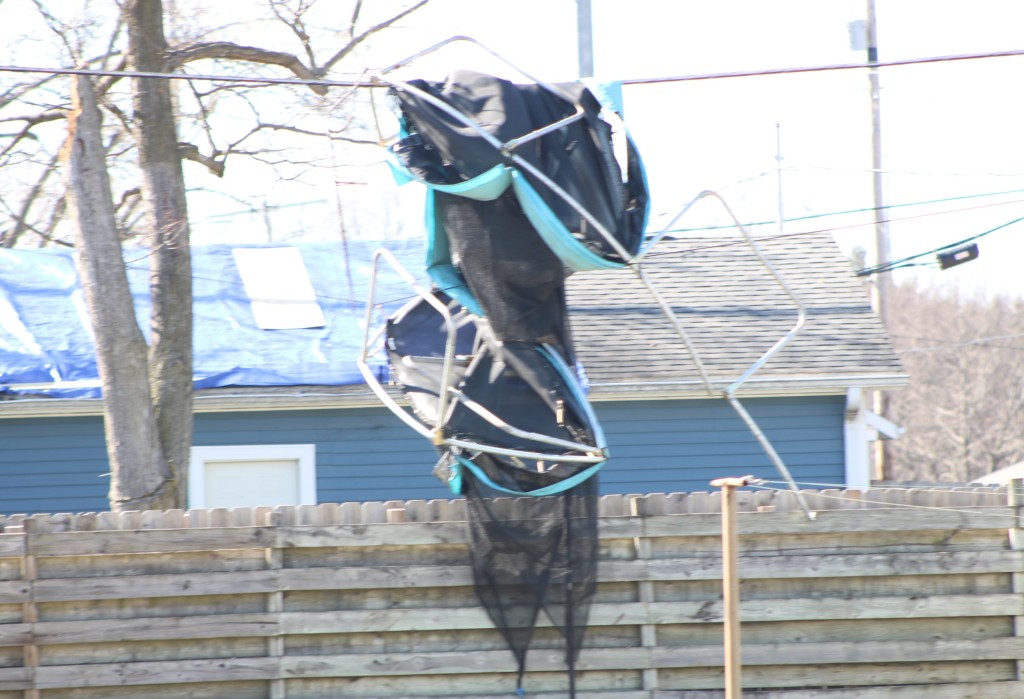
The storm caused significant damage to homes, businesses, and public facilities including major damage to a Menards store and nearby commercial buildings. Multiple people were injured, but no fatalities have been reported in Three Rivers.
Elsewhere in southwest Michigan, the storm proved deadly. Three people were killed by an EF-3 tornado in the Union Lake area near Union City in Branch County, while a 12-year-old boy died after a separate tornado struck the Edwardsburg area in Cass County.
Following the storm, Governor Gretchen Whitmer declared a state of emergency for Branch, Cass, and St. Joseph Counties.
“Our entire state is wrapping its arms around Three Rivers, Union City, Edwardsburg, and everywhere in between. Our hearts are with the families who lost loved ones and the Michiganders who were injured,” Whitmer said in a press release before touring the damage Sunday with Michigan State Police in a helicopter.
The declaration allows the state to deploy additional resources to support local response and recovery efforts in the affected counties.
As Johnston noted, for many residents the storm unfolded in a matter of minutes.
Jennifer Nerad had just started shopping inside Meijer when a friend texted her that tornado sirens were going off.
“In the store, nothing was really happening at first,” Nerad told Watershed Voice. “So I just walked toward the back of the store where I knew the tornado shelter area was. Nobody else seemed to be doing anything yet. Maybe five or 10 minutes later my phone went off with the warning, and then the loudspeakers announced there was a tornado spotted in Edwardsburg heading this way. They told everyone to go to the back bathroom area and the break room, so that’s where everybody ended up.”
Nerad says she has always been terrified of storms and found herself pacing inside Meijer’s shelter area before another announcement came over the loudspeakers warning customers the tornado was headed toward the store and that they needed to take shelter immediately. A woman Nerad noticed sitting nearby with an open seat caught her eye and patted the chair next to her.
“So I went over and asked, ‘Can I hold your hand?’” Nerad said. “She said, ‘Yes, of course.’ She told me her name was Janine, so I introduced myself and apologized. I said, ‘I’m really scared of storms. I’m also autistic, so this is a lot for me.’ She was so kind and patient. She told me she had just retired after spending most of her life as a special education teacher.”
Nerad sat with the woman, who introduced herself only as Janine, for the duration of the storm while Janine kept her distracted with small talk and simple questions.
“They [Meijer] had the little kids all under the tables, and the lights were going on and off,” Nerad said. “Janine just kept talking to me the whole time and asking me questions. She asked things like when I was diagnosed, and we were just chatting while all of this was happening. I was shaking the whole time.”
Eventually, Nerad said, the storm passed. She thanked Janine — who she later described as an “angel” — and stepped outside to assess the damage.

When she eventually left, Nerad said her usual 10-minute drive home from Meijer took over an hour. Debris filled each exit, streets were covered with fallen branches and power lines, and it wasn’t clear where to go. Within minutes, Nerad says a Public Safety officer was on the scene directing traffic out of Meijer. During the drive, Nerad kept realizing the damage stretched much farther across town than she expected.
“I ended up over by Riverside thinking that was probably past where the tornado hit,” Nerad said. “Then I saw that it was damaged there too. It was really hard to get home because I had no idea the storm had hit so many places in town. It was wild — but awful.”
In the days that followed, local volunteers, out-of-state groups, and larger organizations like the American Red Cross banded together to begin the cleanup process. For many, however, homes are still unlivable and their options are running thin.
At one home near the end of South Constantine Street, a tree had crashed through the house. A family appeared to be living in tents set up in the front yard.
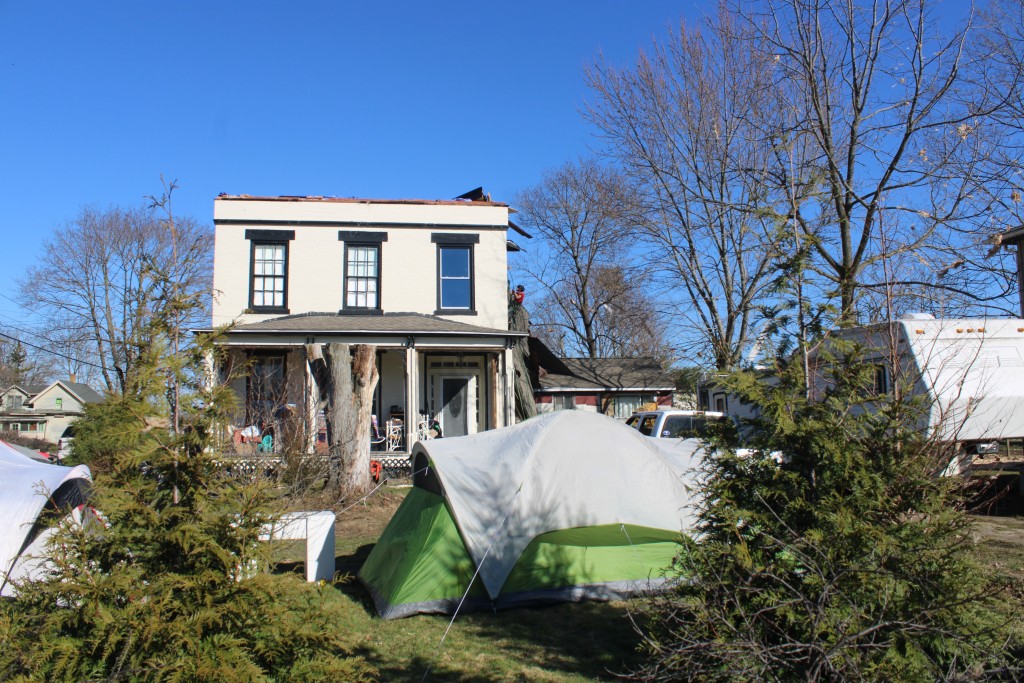
Others are forced to leave their homes entirely awaiting more aid and government funding.
For some, however, the aid felt predatory, targeting people in vulnerable moments and pushing them to make quick decisions. Beth Everett said the storm had barely cleared when people were already knocking on her door offering to fix her roof.
“The sky hadn’t even completely cleared from the tornado when people were already knocking on doors asking, ‘Do you need your roof fixed? Do you need your limbs cut?’” Everett said, clarifying they were contractors looking for work, not volunteers. “It’s like, man — let people catch their breath.”
Mayor Johnston shared a similar experience following last year’s windstorm, when her back deck was damaged.
“My house got damaged and I was signing a contract crying because I didn’t know what else to do,” Johnston said. “The guy kept saying, ‘You want this taken care of, right? You don’t want to fall behind everyone else with storm damage or you’ll be waiting a year.’”
Johnston said she later fired the contractor.
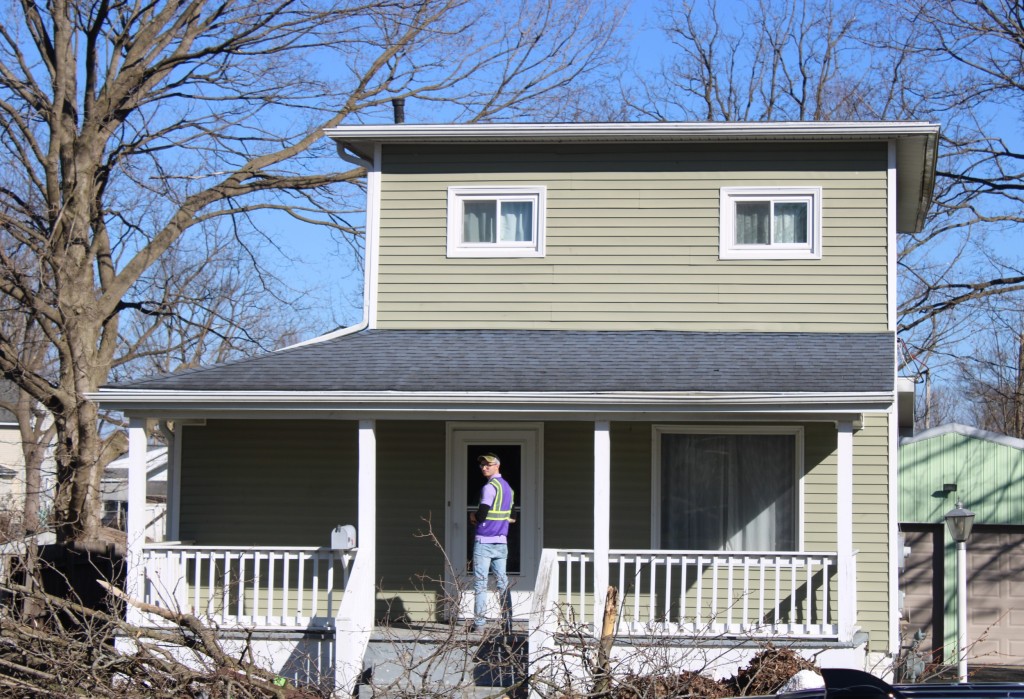
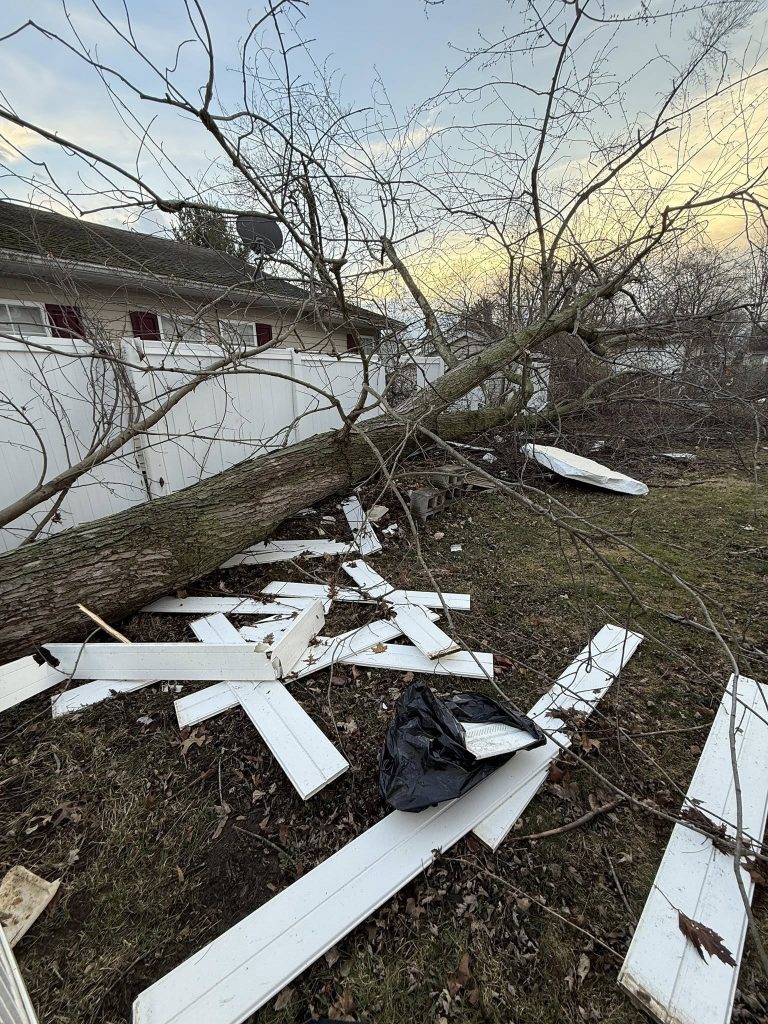
Watershed Voice Executive Editor Alek Haak-Frost, who lives in Three Rivers, said his home was largely spared compared to other residents on his street.
“A large maple tree took out our fence, the gutter on the front of our house is hanging off the roof, and we had a couple of lines over the garage for a few days,” Haak-Frost said. “But we’re so fortunate that no one was hurt. We have plenty to repair but I’ll take a fence in need of mending over a person any day.”
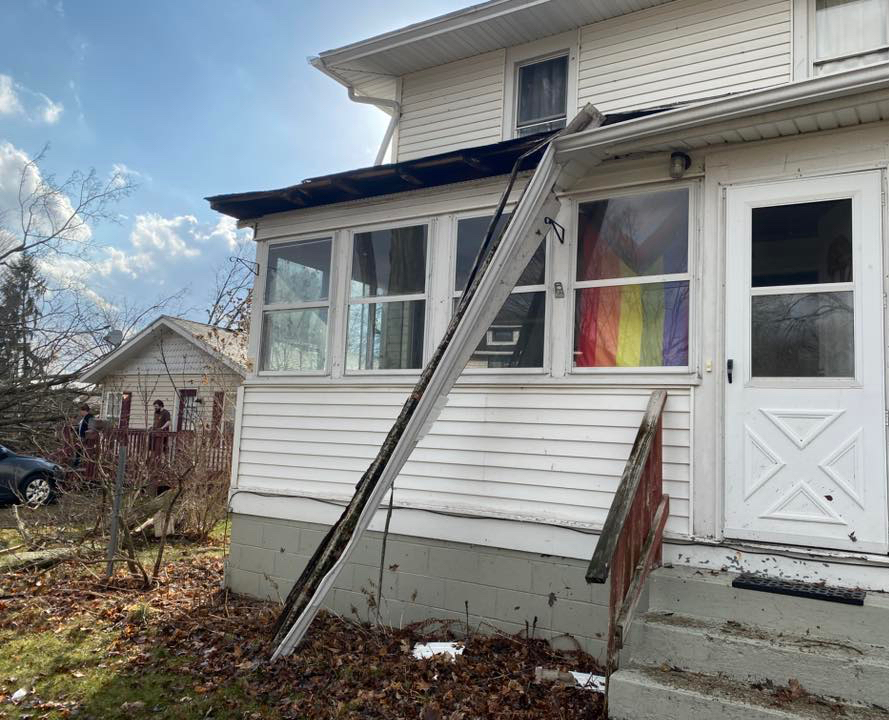
The American Red Cross will work with the city’s emergency management team to assess damage before reporting to state and federal officials to determine what aid may be available, Mayor Johnston told Watershed Voice.
As cleanup continues across Three Rivers, residents are still assessing damage and leaning on neighbors for help — the same way many did in the hours immediately after the storm. Watershed Voice will continue reporting on the storm’s aftermath and resources available to those affected. If you have any additional stories or information to share, please email maxwell@watershedvoice.com.
Maxwell Knauer is a staff writer for Watershed Voice.
Author

Related Articles

Michigan lawmaker explores changes to public notice rules, raising transparency concerns
Municipalities pay newspapers to publish these notices, with costs varying based on the number and length of postings.
According to recent Three Rivers City Commission agenda packets, the city paid $740 to the Three Rivers Commercial-News for fiscal year 2026 public notices. A separate payment of $290 for the same category was recorded February 13.
If lawmakers pursue changes, they could alter where and how notices are published, potentially shifting some requirements away from newspapers. However, state Rep. Sarah Lightner (R-Springport) has said she is not seeking to eliminate public notice requirements altogether.
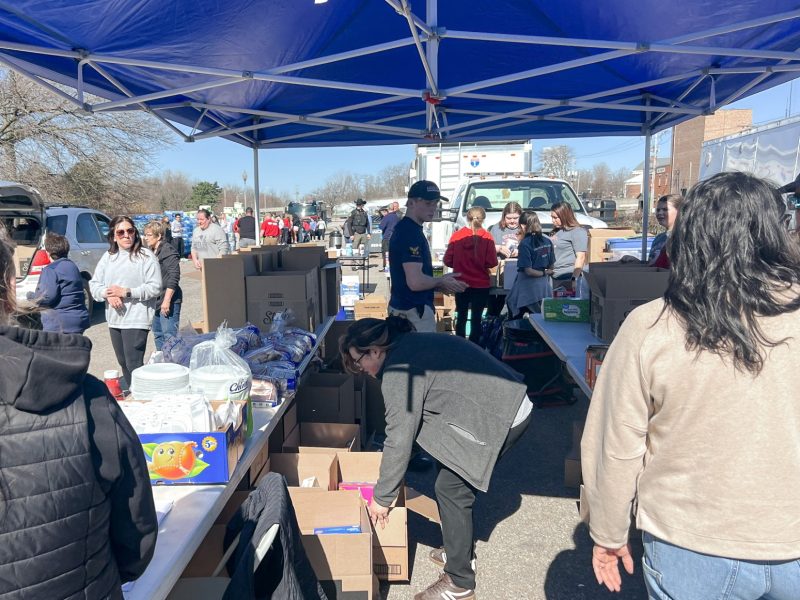
Three Rivers Area Community Foundation awards $20,000 grant to St. Joseph County United Way for tornado recovery
Together with support from the Sturgis Area Community Foundation (SACF), a combined $20,000 grant has been awarded to the St. Joseph County United Way to assist individuals and families impacted by the storm.

Keep Your Voice Down: Let’s Talk About Cake
Canadian journalist and baker Chantal Hortop, who serves as managing editor of The Gleaner in Quebec, stops by Keep Your Voice Down to talk cake and shop with hosts Doug Sears, Jr. and Alek Haak-Frost. The wide ranging conversation includes how Chantal and Alek met, the impact of the LION Independent News Sustainability Summit on both their organizations, what local journalism looks like in Canada, and Chantal’s penchant for creating dazzlingly delicious baked goods.
