
White Pigeon residents still grappling with years-long water quality issues tied to pipeline project
Issues began during a road-widening project along U.S. 12, when the village replaced a key section of its water main. The contract for a proposed $12.4 million project to overhaul White Pigeon’s water distribution system is expected to be awarded in July.

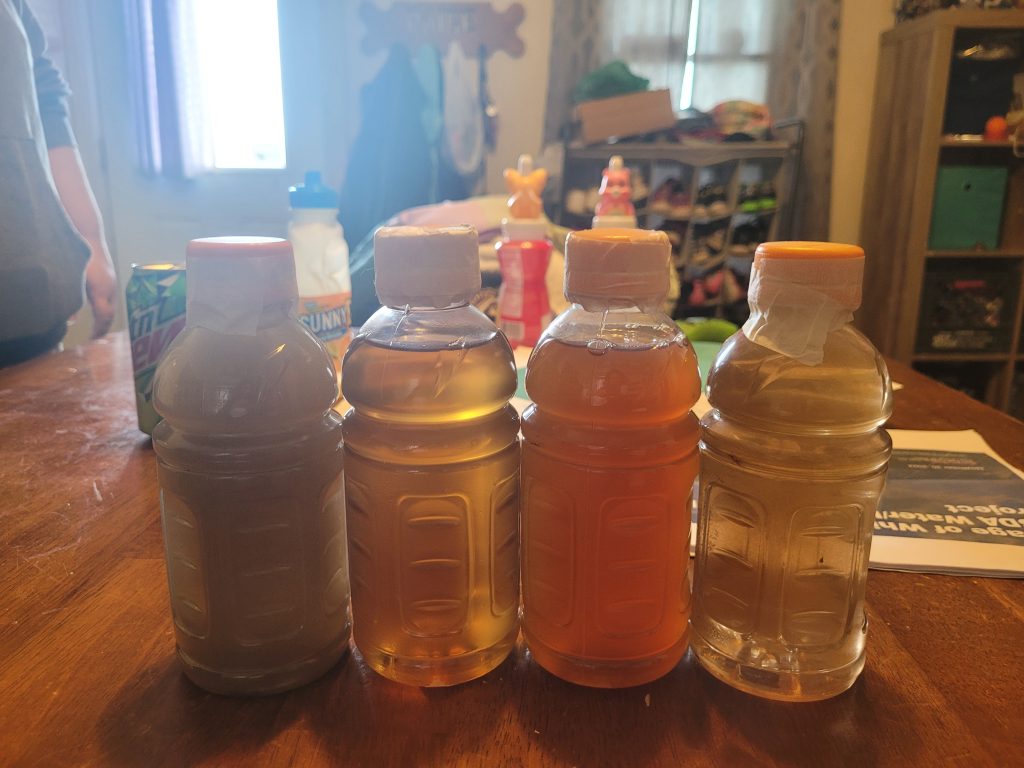
For the past five years, Catie Baldwin hasn’t trusted the water flowing from her tap. The water supplied by the White Pigeon Village system is — according to Baldwin — brackish, full of sediment, and undrinkable.
“I won’t let my family drink it,” Baldwin said from her kitchen, holding up a used water filter encrusted with sediment. Her family of five relies on bottled water for drinking, which costs about $150 a month. For everything else — dishwashing, laundry, and bathing — the water runs through a dual-filtration system she installed in her basement. A $45 two-pack of filters barely lasts a month.
“We couldn’t use the water anymore,” she said. “We have two filtration systems just to make it usable for daily tasks.” She said she’s already had to replace several household appliances damaged by the water’s poor quality.
Baldwin’s experience is not unique. A number of residents in the Village of White Pigeon, particularly those in the northwest quadrant of the village, are grappling with similar issues.
Bacterial contamination leads to discolored, sediment-rich water
While it’s unclear exactly when White Pigeon’s water quality began to decline, the inciting incident likely occurred during a road-widening project along U.S. 12 between 2020 and 2022, when the village replaced a key section of its water main. The project’s contractor, South Bend-based Jones Petrie Rafinski (JPR), has worked with White Pigeon since 1994.
The system experienced a bacterial contamination in the process of that work. In response, the Michigan Department of Environment, Great Lakes, and Energy (EGLE) required the village to chlorinate its water supply — a treatment that hadn’t been used before in White Pigeon. That chlorine, combined with mineral buildup in the aging pipes, created discolored and sediment-rich water.
“Over the last five years, we’ve had way more boil water advisories,” Baldwin said. “When I was growing up, I remember maybe one. Now it’s routine.”
Former village board member and local business owner Kurt Alwine claims the contamination could have been avoided.
“They connected the new pipes in the trench and allowed dirt inside,” said Alwine, who was on the board at the time. “Then the water started failing bacteria tests. It had dirt and bacteria in it.”
Alwine alleges the project was awarded to JPR because it was the lowest bidder, and that corners were cut during construction. JPR denies responsibility for White Pigeon’s current water problems.
In an email to Watershed Voice, JPR Chief Financial Officer Kenneth Jones attributed the water discoloration to decades of mineral accumulation from Well No. 3, which serves the affected area.
“Since 2001, minerals have been deposited on the internal pipe walls,” Jones wrote. “During and after the 2022 infrastructure project, discoloration became more noticeable to homeowners.”
The affected area includes homes and businesses along U.S. 12, Vermont Avenue, Michigan Avenue, and Elkhart Street — all connected to Well No. 3, which has the highest mineral levels. Jones wrote, “However, because the distribution system is essentially an interconnected grid, it is possible that there is some amount of minerals residing in 100% of the system.”
EGLE acknowledges the water’s discoloration but maintains it poses no health risk. Heather Bishop, district supervisor for EGLE, said while the construction project may have been the source of the bacterial contamination, that doesn’t necessarily imply fault by any party — it could have occurred without negligence.
According to EGLE, the discoloration, bad taste, and odor are classified as “aesthetic” issues under Michigan’s Safe Drinking Water Act — not health hazards.
“White Pigeon’s water system historically wasn’t treated,” Bishop said. “When we required chlorination during the construction project, they couldn’t stop without continued positive tests for total coliform bacteria, so it’s stayed on.”
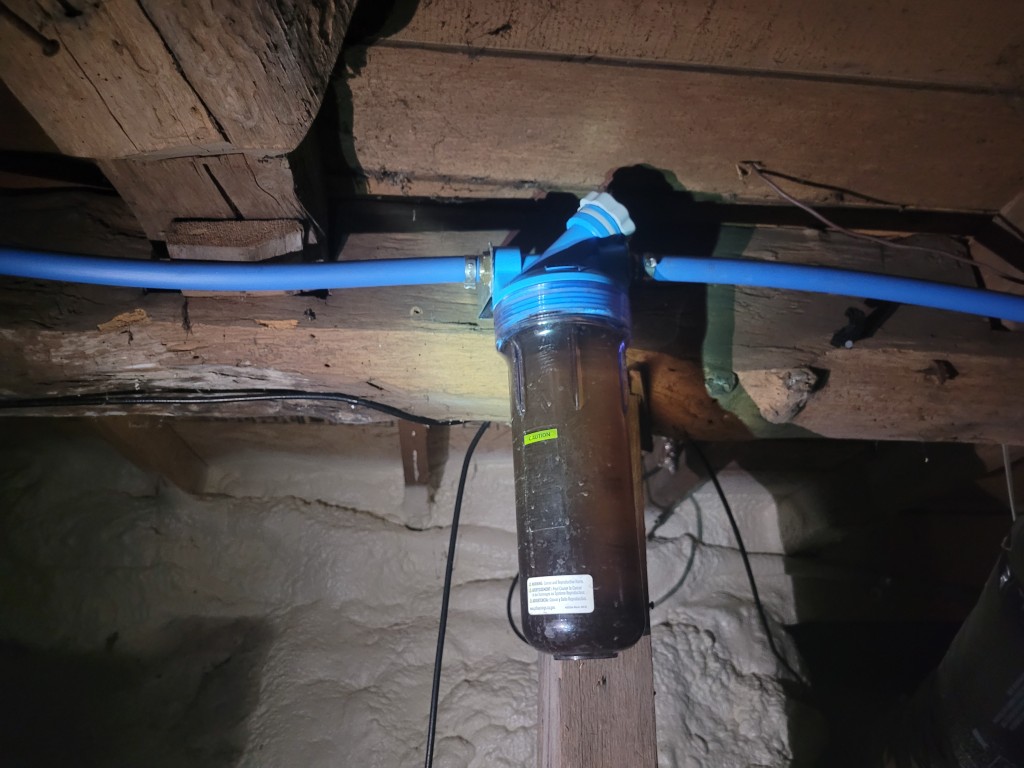
Total coliform itself isn’t harmful but signals potential contamination. Chlorination is now necessary to keep the system safe — but it’s also causing visible chemical reactions inside the old pipes.
“The chlorine oxidizes minerals like iron and manganese,” Bishop explained. “That causes particles to form, leading to the orange and brown water people are seeing.”
Manganese levels tested by EGLE were below health advisory thresholds, she said, so no regulatory action has been taken.
A costly fix ahead
After repeated complaints, the village is moving forward with a $12.4 million plan to overhaul its entire water distribution system. JPR is again the proposed contractor for the project.
The plan, outlined in a memo to the Village Board in November 2024, would replace 85% of the village’s distribution lines and 80% of individual connections. Funding would come from multiple sources: a USDA Rural Development loan, state and local grants, and additional borrowing at a 5.5% interest rate over 15 years.
Currently, residents pay about $49.17 per quarter to cover debt from the 2020 pipeline replacement. Under the new proposal, that would rise to $270.62 per quarter.
“The problem is, no one planned for the future,” said Village Board President Jeff Wagaman. “Now, we have no choice but to pay extra to fix a system that should’ve been maintained decades ago.”
Villagers are not happy with the price hike either. Some residents are frustrated the village is hiring the same contractor they hold responsible for village’s current water issues.
Jerry Cash, who owns a home and auto dealership on Main Street, said his property was damaged during the 2020 construction.
“They tore up my yard, my sewer line, and didn’t fix it,” Cash alleges. “To hire them again? That’s insane. It’s like doing the same thing and expecting a different result.”
In response to criticism regarding JPR’s involvement in the upcoming overhaul, and its prior work, Jones welcomes village residents to contact company staff with any questions regarding the project.
“JPR is a multi-disciplined Professional Services company that provides Civil Engineering Design Services to the Village of White Pigeon,” Jones wrote. “We are not a general contractor that installs water systems. We are committed to mitigating the issue by doing everything that we are qualified to do to help the Village complete the next round of water infrastructure system improvements. We have been to almost every Village Council Meeting for many years and our staff make themselves available to answer any questions from homeowners and/or residents that pertain to the proposed improvements at all times throughout any such project.”
JPR is seeking final approvals from EGLE and the USDA, with the contract expected to be awarded in July.
Najifa Farhat is a reporter with Watershed Voice.
Author

Related Articles
Local meeting primer: Sturgis City Commission
The Sturgis City Commission will meet Wednesday, August 26, to consider a $300,000, four-year biosolids removal contract, a $660,088 bid for the Nottawa Street transmission line project, and a $452,128 installment purchase agreement for a new digger/derrick truck.
Commissioners will also consider engineering services for the 2027 sidewalk program, additional work on the Sturges-Young entryway project, and a railroad crossing addendum.

Southwest Michigan Journalism Collaborative to host session about finding trustworthy news in the age of AI
The free event, which includes dinner and discussion, will be suitable for teens and adults, and feature Western Michigan University School of Communication Professor Sue Ellen Christian, who will share tools, tips, and tactics on how to spot misinformation and manipulated images, and what to look for to identify quality news sources. Participants will need a charged smartphone to participate fully in the workshop.
Three Rivers approves new website as livestream plans remain in development
During public comment, resident Austin Kane urged commissioners to begin livestreaming their meetings again. This prompted Mayor Angel Johnston to ask City Manager Joe Bippus for an update on the commission’s June 16 direction for Bippus to explore city-run livestreams.
“We’re probably developing an RFP (request for proposal) that we’ll send out,” Bippus said, in part.
Johnston then asked Bippus when the system would be ready, Bippus said he did not know.
