
Michigan Court of Claims allows PIHP procurement to proceed
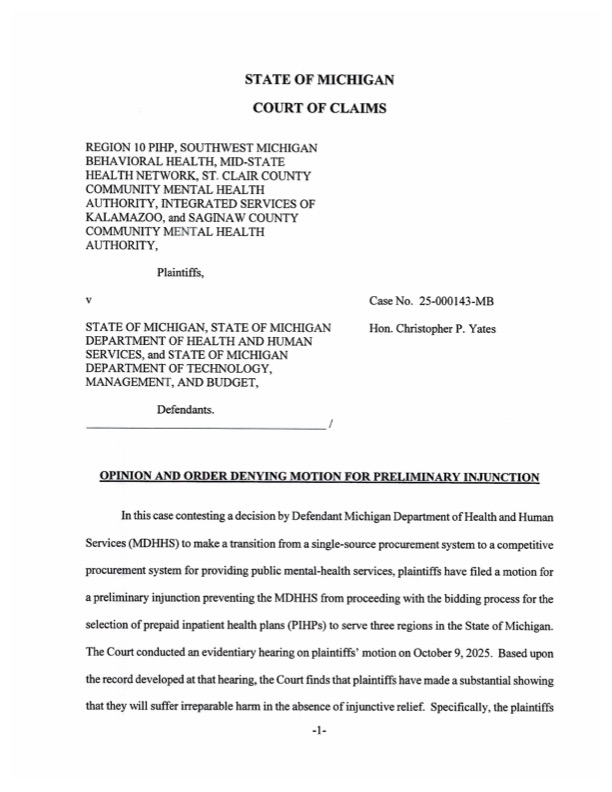
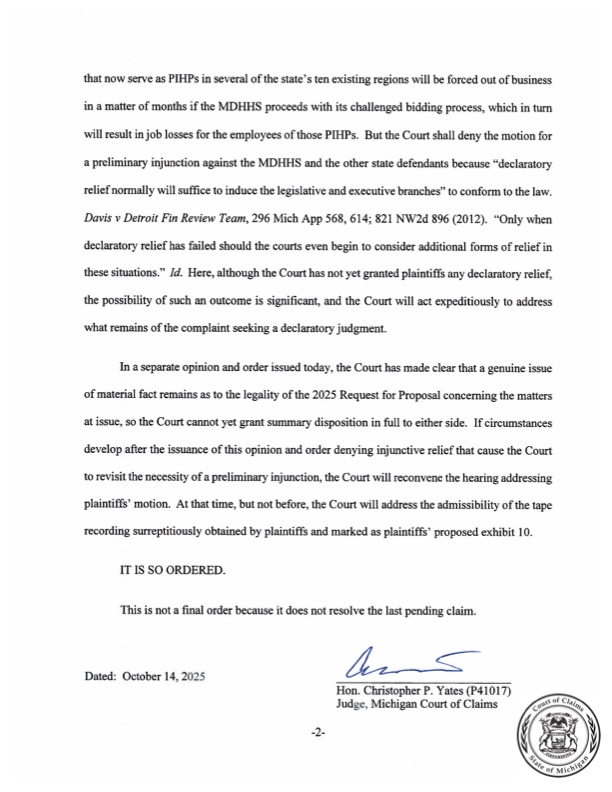
Judge Christopher P. Yates wrote in his October 14 opinion that while the changes “may seem unwise,” nothing in state law prevents the Michigan Department of Health and Human Services (MDHHS) from implementing them.
If the state proceeds as planned, the 10 existing PIHP (prepaid inpatient health plan) regions — including Southwest Michigan Behavioral Health — would be dissolved after fiscal year 2026, and the new regional entities would begin managing Medicaid mental-health funding in FY 2027.

The Michigan Court of Claims has ruled that the state’s Department of Health and Human Services (MDHHS) can move forward with its plan to reduce the number of prepaid inpatient health plan (PIHP) regions from 10 to three, a major restructuring of how Medicaid mental health services are managed across the state.
Judge Christopher P. Yates wrote in his October 14 opinion that while the changes “may seem unwise,” nothing in state law prevents MDHHS from implementing them.
“However unwise the changes may seem, nothing in Michigan law precludes the Michigan Department of Health and Human Services from making them,” Yates wrote. “Thus, the Court lacks the authority to invalidate the changes in the number and geographic scope of the regions serviced by PIHPs.”
The lawsuit was filed by Region 10 PIHP, Southwest Michigan Behavioral Health, Mid-State Health Network, St. Clair County Community Mental Health Authority, Integrated Services of Kalamazoo, and Saginaw County Community Mental Health Authority against the State of Michigan, MDHHS, and the Department of Technology, Management and Budget (DTMB).
The plaintiffs challenged a 2025 Request for Proposals (RFP) that consolidates the current 10 PIHPs, which oversee publicly funded behavioral-health services through Medicaid, into three larger regions. They argued that the process effectively bars existing regional entities from competing for contracts and violates provisions of the state Mental Health Code (MCL 330.1204b).
“None of the 10 current PIHPs can satisfy the requirements to bid under the 2025 RFP, so all 10 of them will be dismantled after fiscal year 2026,” the court document states.
Plaintiffs said the “full-region bid requirement” prevents smaller, community-based regional entities from participating, undermining decades of local collaboration among community mental-health service programs (CMHSPs).
Yates acknowledged that concern, calling the state’s approach “unwise given the history of those existing PIHPs with the program and their strong connections with CMHSPs and providers.” But he emphasized that questions about the wisdom of policy decisions belong to MDHHS and the Legislature, not the courts.
The court found that MDHHS has legal authority to both reduce the number of regions and shift from a single-source system — where each region had one designated PIHP — to a competitive procurement model. That approach, Yates wrote, aligns with federal preferences favoring competition in Medicaid contracting.
“The federal preference for competitive procurement is so strong that, for years, the MDHHS has had to obtain federal authorization to maintain its single-source procurement system,” the opinion states. “MDHHS is simply taking proactive steps to bring Michigan into compliance with the federal mandate of competitive procurement.”
While siding with the state on those structural questions, the court did not close the case entirely. Yates left unresolved whether parts of the RFP improperly assign functions to PIHPs that, by law, must remain with CMHSPs under the Mental Health Code. Because that issue involves “a genuine issue of material fact,” he denied summary disposition to both sides on that point.
In practical terms, that means the judge found there’s still an open question about whether the new contracts comply fully with state law, but his ruling allows the state to continue the procurement process while that narrower issue is reviewed.
“The record does not enable the Court to determine whether CMHSPs are actually or potentially fatally impaired by the language of the 2025 RFP so the Court cannot yet enter an order awarding summary disposition to either side,” Yates wrote.
What’s next
The ruling allows MDHHS and DTMB to continue the bidding process while the unresolved question about CMHSP functions remains before the court. MDHHS may now solicit proposals from nonprofit, governmental, or university-based bidders capable of operating across one or more of the three new regions beginning October 1, 2026.
As Watershed Voice previously reported, MDHHS officials and stakeholders have indicated the most likely bidders would be private, nonprofit health insurance organizations with the capacity to manage large regional networks.
A separate ruling will address the plaintiffs’ request for an injunction that would temporarily block contract awards while the remaining legal question is settled. Plaintiffs could also appeal Yates’ decision to the Michigan Court of Appeals once a final order is issued.
If the state proceeds as planned, the 10 existing PIHPs — including Southwest Michigan Behavioral Health — would be dissolved after fiscal year 2026, and the new regional entities would begin managing Medicaid mental-health funding in FY 2027.
Per Watershed Voice‘s previous reporting, local mental-health officials have warned that consolidating the system could erode community relationships built over decades.
“I spend a great deal of time building relationships with our providers to make sure they’re supported so they can, in turn, support our clients,” Amy Davidhizar, provider network manager at Woodlands Behavioral Healthcare Network, previously told Watershed Voice. “With this procurement process, you lose that local knowledge, that local concern and care.”
“I worry our clients will just become numbers in a system,” Davidhizar said. “We’ve built a safety net that only works because of trust and follow-through. That doesn’t exist when decisions are made hundreds of miles away.”
Maxwell Knauer is a staff writer for Watershed Voice.
Editors note: This article has been updated to reflect that Integrated Services of Kalamazoo is a CMHSP, not a PIHP, so it will not dissolve after Fiscal Year 2026. The update was made at 11:54 a.m. on Thursday, October 16.
Author

Related Articles
Local meeting primer: Three Rivers City Commission
The Three Rivers City Commission will meet Tuesday, March 3 to consider a city-wide mowing contract, water meter replacements, winter salt funding, and adding Farrand Hall Diner to the downtown social district.
As noted previously, Watershed Voice will be live-streaming the City Commission meeting on its Facebook page, and will upload the video to YouTube after. All Three Rivers City Commission meetings will be live-streamed and uploaded going forward.

Local residents to “Stand Up for Science” at Main Street Bridge in Niles
“Science isn’t abstract — it affects our families, our hospitals, our water, our weather forecasts and our jobs,” organizers said in a statement. “We chose this location intentionally. Every day, people cross this bridge seeking medical care made possible by decades of scientific research. This rally is about recognizing that connection and standing up for the science that keeps our community healthy and strong.”

Huss Project offering paid summer internship for WMU students in Three Rivers
The 10-week internship generally runs through the organization’s Back to School Celebration at the August Second Saturday Farmers Market. Interns are paid $17.50 per hour and are expected to work about 20 hours per week. Every other week, they attend professional development training at Western Michigan University as part of the Broncos LEAD program.
For Co-founder Rob Vander-Giessen Reitsma, the internship is about more than seasonal help — it’s about formation.
“We hope students learn about small-scale food production, community development in a small town, and how our work is rooted in the core values of our organization,” he said.
