
Final opportunity for Sturgis residents to provide recycling feedback before ordinance moves forward
Wednesday’s meeting will feature the second reading of the ordinance. If approved, the city would enter a 20-day waiting period before the measure becomes law. The commission will also need to decide the length of its next contract with Borden — likely between one year, which allows flexibility if prices change or the commission later discontinues recycling, and three years, which would reduce per-household costs through volume pricing.

The Sturgis City Commission will meet Wednesday, November 12, at 6 p.m. in the Wiesloch Raum at City Hall, 130 N. Nottawa St., where commissioners will hold the second and final reading of the city’s proposed recycling ordinance and consider several zoning changes.
Wednesday’s meeting will likely begin the process of formalizing the commission’s decision on the months-long recycling controversy. Following the second reading, a majority vote in favor would trigger a 20-day waiting period before the ordinance takes effect on December 4, 2025.
When the commission decided to adopt an ordinance rather than send the issue to a citizen vote, members said they wanted to use the first and second readings to gather resident feedback before making a final decision. During the October 22 meeting — the ordinance’s first reading — public feedback was minimal, with only one resident commenting.
Residents are encouraged to attend Wednesday’s meeting to share their views before the measure advances.
How we got here
On July 23, the Sturgis City Commission voted to end the city’s curbside recycling program at the end of the year due to the expiration of its contract with Borden Waste-Away Service and sharply rising renewal costs. The change would have left a $150,000 shortfall in city funding even with higher service fees, according to City Manager Andrew Kuk and previous commission discussions.
That vote drew swift backlash. Commissioners received dozens of calls and emails urging them to reconsider. During an August 13 meeting, City Hall was packed with residents advocating for continuation of curbside service.
By September 24, Kuk presented a new set of options in response to that public pushback. Chief among them was a plan to treat recycling as a city utility service funded by residents through their monthly utility bills — an idea that later became the foundation of the current ordinance.
The payment structure had been a sticking point in the commission’s original decision to cut the program, as the city’s rate cap for residential services left no way to recoup all costs without drawing from the city’s fund balance. Other options considered included placing the issue on the ballot, a one-year stopgap renewal with Borden, or shifting to a drop-off site model.
At the October 8 meeting, Kuk presented a draft ordinance written by City Attorney T.J. Reed. A motion by Commissioner Marv Smith to reject the ordinance failed, after which Commissioner Jeff Mullins, seconded by Commissioner Aaron Miller, moved to schedule the first reading for October 22. The motion passed 6-2, with Smith and Mayor Frank Perez opposed, as previously reported by Watershed Voice.
Smith and Perez have consistently opposed reinstating curbside recycling, citing concerns about adding costs for constituents they say have mixed interest in the service.
During the October 22 meeting, Kuk presented the ordinance for its first reading. After limited discussion and no substantial public comment, Commissioner Cathi Abbs moved to approve the first reading, seconded by Commissioner Linda Harrington. The motion passed 7-2, with Harrington, Abbs, Boring, Wickey, Bir, Miller, and Mullins in favor, and Perez and Smith opposed.
What happens next
Wednesday’s meeting will feature the second reading of the ordinance. If approved, the city would enter a 20-day waiting period before the measure becomes law. The commission will also need to decide the length of its next contract with Borden — likely between one year, which allows flexibility if prices change or the commission later discontinues recycling, and three years, which would reduce per-household costs through volume pricing.
The ordinance would formally establish recycling as a city utility service, charging property owners a monthly fee — estimated between $6 and $8 depending on contract length — to cover collection costs. It defines eligible participants as “Residential Units” instead of the previous “dwelling units,” automatically including properties with one to three units such as single-family homes, duplexes, and triplexes.
In response to resident concerns about multi-unit rentals, staff drafted an alternate version limiting eligibility to single-unit properties, exempting about 36 parcels (roughly 2.6 percent of current users) while allowing the commission to later offer voluntary inclusion. Other provisions — including billing, enforcement, and the ordinance’s sunset date of December 31, 2026 — remain unchanged.
Other business
Also on Wednesday’s agenda is the first reading of a proposed zoning change for 408 W. Congress St., submitted by Commissioner Dan Boring. The property would shift from the Manufacturing (M) zoning district to Residential 3 (R-3).
According to city staff, Boring owns the adjacent property at 406 W. Congress, which he plans to convert into a single-family dwelling. The rezoning would allow him to demolish a deteriorating industrial structure at 408 W. Congress and use the parcel for parking and accessory use for the home.
Other new business items include additional zoning changes, public works equipment purchases, and capital maintenance projects listed in the agenda packet.
Perez reappointed
The Sturgis City Commission also held its annual organizational meeting Monday, November 10, during which commissioners voted to reappoint Frank Perez as mayor for a third term. In a press release Tuesday, Perez said he intends to prioritize a comprehensive review of the city charter and a critical examination of the zoning ordinance.
“Our City Charter was adopted on February 15, 1921, with its last amendments made on November 2, 2004. A comprehensive review is long overdue to ensure it accurately reflects the needs and operations of our city,” Perez said.
He added, “We need to ensure our zoning regulations are business-friendly, investor-friendly, and resident-friendly. I intend to work with the commission to review our existing regulations that might be hindering growth or creating unnecessary difficulties for working and conducting business within our city.”
Perez thanked residents for “entrusting me with this continued honor” and said he looks forward to the work ahead.
Maxwell Knauer is a staff writer for Watershed Voice.
Author

Related Articles

Drew Duncan says policy saved his life — now he’s shaping it
“My life was saved because of the Affordable Care Act,” Kalamazoo City Commissioner and Vice Mayor Drew Duncan said. “Without it, I would not have received care.”
Now 36, Duncan sees that period — when he was diagnosed in late 2009 and underwent treatment through 2011 — as foundational. It was the moment policy stopped being abstract.
“I have a story that is like many people — but maybe not a story people would expect,” he said. “I try to enter the room with a listening posture. I see urgency around the issues that are plaguing my constituents.”
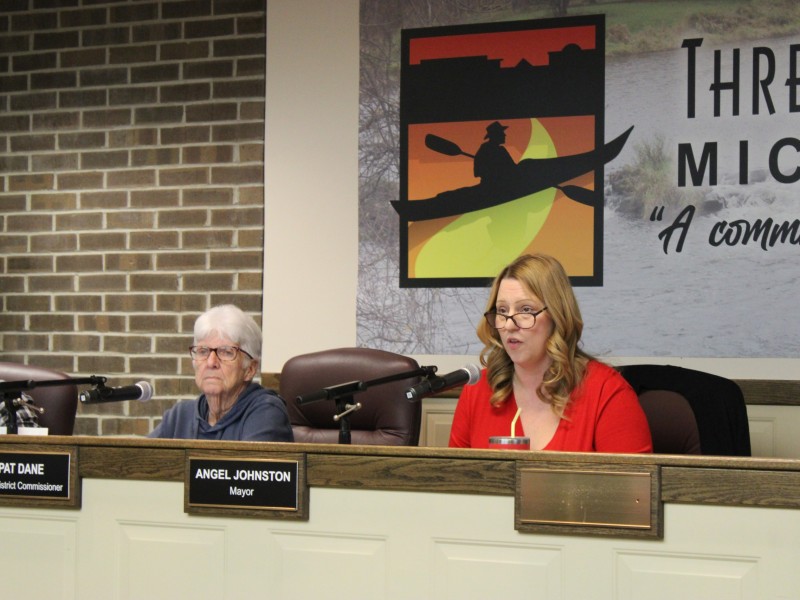
Three Rivers Commission approves early voting update, demolition contract
Commissioners unanimously approved all agenda items, including an amendment to the county early voting site agreement, a box hangar lease transfer, and the demolition of 318 S. Main St.
Three Rivers Promise surpasses $1 million in fundraising campaign
Three Rivers Promise has raised more than $1 million toward its goal of creating a long-term scholarship endowment for graduates of Three Rivers High School.
The organization is in the initial phase of a community fundraising campaign aimed at building a self-sustaining fund to support tuition assistance for eligible graduates.
