
Michigan state senator moves to guarantee marriage equality in Michigan constitution
Because the Michigan Constitution can only be amended through a voter-approved ballot measure, Senate Joint Resolution F, must first secure a two-thirds majority in both legislative chambers. In the Senate, that means 25 votes. Democrats hold 19 seats, and Sen. Jeremy Moss said all have co-sponsored the resolution, leaving six Republican votes needed for passage.
If approved by the Senate, the resolution would move to the House, where a two-thirds vote is also required – 73 votes total. Republicans currently hold a 58–52 majority.

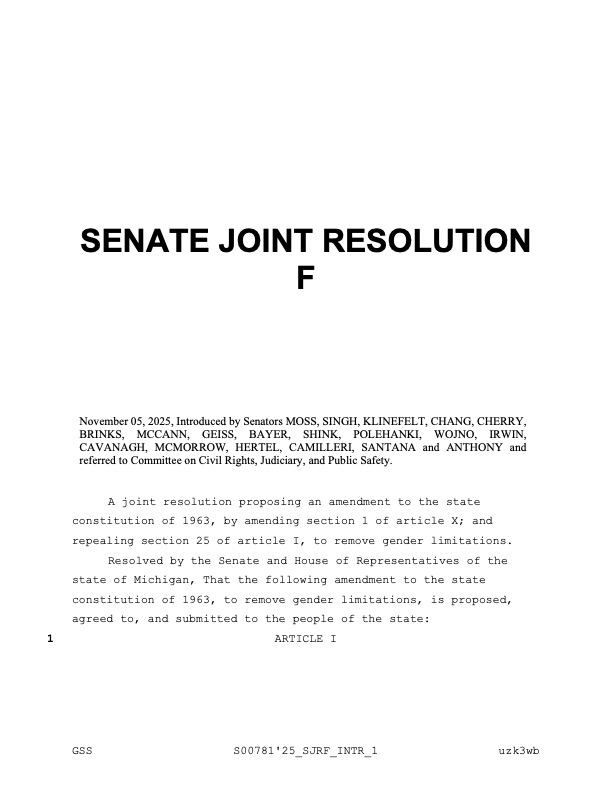
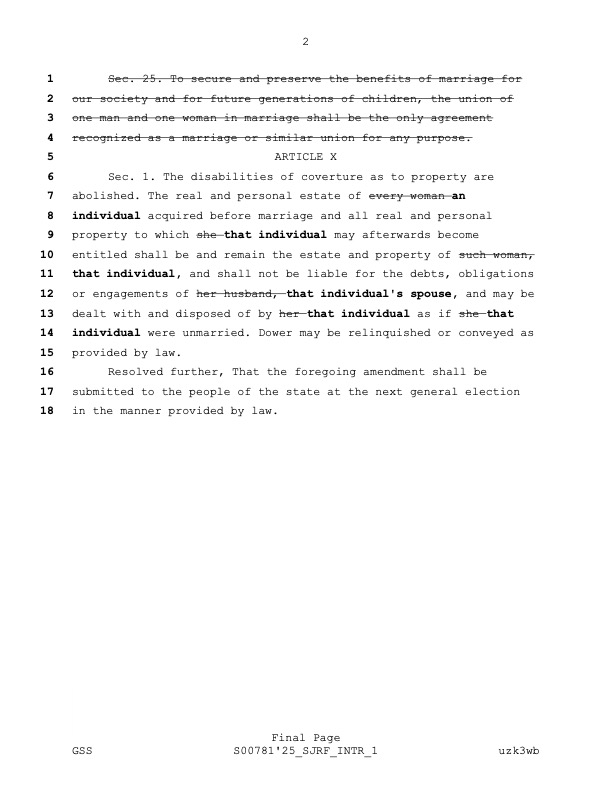
Currently, the Michigan Constitution defines marriage in Article I, Section 25 as: “the union of one man and one woman in marriage shall be the only agreement recognized as a marriage or similar union for any purpose.”
Sen. Jeremy Moss has put forward Senate Joint Resolution F, which would repeal that section and amend Article X, Section 1 to remove gendered language, replacing terms such as “woman” and “husband” with gender-neutral references like “individual” and “spouse.”
“We live in a post-Roe world,” Moss told Watershed Voice, citing a need to protect marriage rights for all regardless of future federal court decisions.
Moss is the first openly gay person to serve in the Michigan Senate and the second in state legislative history.
On Monday, the U.S. Supreme Court declined to hear a challenge seeking reconsideration of Obergefell v. Hodges, the landmark 2015 decision that legalized same-sex marriage nationwide. The refusal leaves Obergefell intact for now, but Moss said it offers little reassurance.
“Supreme Court decisions are, sadly, now only a moment in time and subject to a future case and a future court to make a completely opposite decision,” he said. “So we have to stand up for ourselves. We can’t let the future of the Supreme Court dictate our destiny.”
Moss hopes Michigan will follow California, Colorado, and Hawaii, all of which have passed state-level protections for marriage equality.
Because the Michigan Constitution can only be amended through a voter-approved ballot measure, SJR F must first secure a two-thirds majority in both legislative chambers. In the Senate, that means 25 votes. Democrats hold 19 seats, and Moss said all have co-sponsored the resolution, leaving six Republican votes needed for passage.
If approved by the Senate, the resolution would move to the House, where a two-thirds vote is also required – 73 votes total. Republicans currently hold a 58–52 majority.
If SJR F clears both chambers, the proposed amendment would go before voters in the next general election.
“Marriage equality is a settled issue in Michigan,” Moss said. “Anybody who wants to relitigate that is on the other side of where most Michiganders are. So we have to push forward, to strip this language from our constitution to protect the rights of everybody in our state.”
Local support
Alexis Jacobs, Three Rivers Pride secretary, said Moss’s proposal resonates deeply in southwest Michigan. Jacobs grew up in Three Rivers and has worked with the organization for three years, helping create “a space for inclusivity, representation, connection, and celebration for queer folk and allies.”
She said the resolution is “a really important proactive move,” especially given uncertainty around future Supreme Court decisions. “Although the Supreme Court did dismiss the challenge to review Obergefell v. Hodges, it doesn’t mean they won’t in the future,” she said. “I’m hopeful this proposal passes to protect marriage rights for everyone.”
For LGBTQ+ families in Three Rivers and surrounding communities, Jacobs said constitutional protections would matter. “There are plenty of LGBTQ+ couples and families in Michigan,” she said. “Also there are plenty of queer young people who may someday decide to marry, and they like everyone else should be able to make that choice.”
Jacobs described the local climate for LGBTQ+ rights as “highly polarized.” While Michigan’s political leadership has shifted in recent years, she noted that southwest Michigan leans conservative.
“(Rep.) Steve Carra is openly anti-queer and he has a lot of support around here,” she said. “We have definitely seen more hateful comments and disapproval of our Pride Festival. That said, we also continue to gain support, and I believe more people are speaking against homophobia and coming together to support our queer community.”
Beyond marriage equality, Jacobs said she worries about broader political trends. “The rise of christofascism scares me for everyone’s sake but especially queer folks,” she said, citing mounting attacks on transgender and nonbinary people, and pressure on health systems to limit gender-affirming care.
“Kids are going to suffer because of this,” she said, pointing to research showing lower rates of depression, anxiety, and suicide among youth who can access affirming care.
Jacobs said residents who want to support LGBTQ+ neighbors can start small.
“A lot of people support LGBTQ+ rights but don’t know what that looks like in practice,” she said. “It can be as simple as having conversations with queer organizers, donating a few dollars to your local pride center, or volunteering your time… Local government can especially call out harmful government leaders calling for proposals that are frankly unconstitutional.”
She said the effort to codify marriage equality is a necessary safeguard, especially after the fall of Roe v. Wade. “I remember being told there was no reason for concern that Roe v. Wade would ever be overturned – and it was,” Jacobs said. “It is entirely possible that the Supreme Court could revisit same-sex marriage, and then interracial marriage, and it continues that way, repealing rights that were hard fought. This proposal is important because it says to our people, ‘You matter, you have the right to marry who you choose, and we will guarantee you maintain that constitutional right.’”
What’s next?
SJR F awaits consideration in the Senate. If it clears both chambers by two-thirds margins, Michigan voters will have the final say on whether to remove the state’s existing ban on same-sex marriage and adopt gender-neutral constitutional language.
Maxwell Knauer is a staff writer for Watershed Voice.
Author

Related Articles
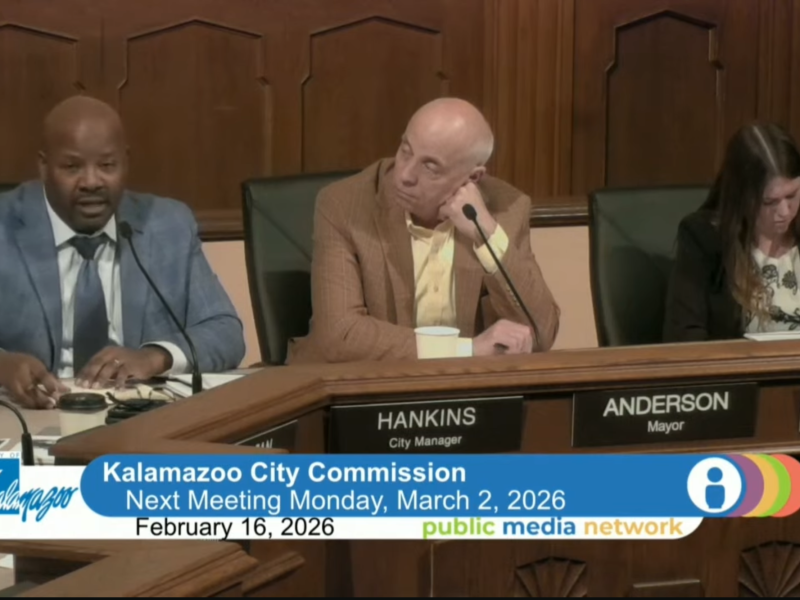
Kalamazoo City Commission tables Safe Routes to School contract amid public pushback
Commissioners voted unanimously to table the item and revisit it at a future meeting. City staff said they plan to prepare additional information, including visuals, and hold a meeting to gather resident feedback before returning to the commission.
“If we postpone it to one more meeting, it’s not going to have a delay on receiving the funds,” Commissioner Jae Slaby said. “It will not jeopardize these funds. It will not jeopardize the contract. So why not just have the due diligence done and send the message to the community that we are hearing their concerns?”
Journalists and advocates gather in Kalamazoo to discuss affordable housing
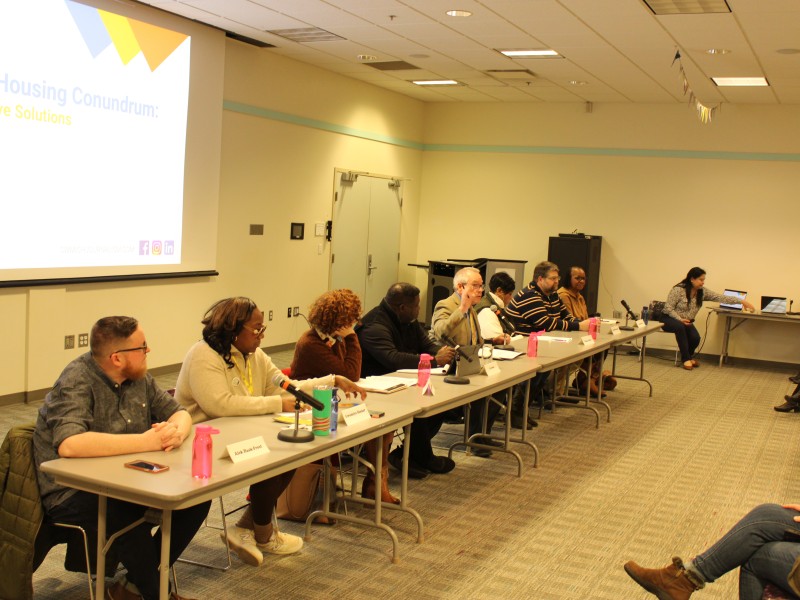
Panelists included journalists who regularly cover housing and community issues — Watershed Voice editor-in-chief and founder Alek Haak-Frost, Brad Devereaux of MLive, Jordyn Hermani of Bridge Michigan, and freelance journalist Al Jones, project editor for On the Ground Kalamazoo — as well as housing advocates Gwendolyn Hooker of Kalamazoo-based Hope Through Navigation, Shanay Settles of the Calhoun County Health Department, and Patsy Moore of Mount Zion Baptist Church and Legacy Senior Living.
Michigan mental health service shift blocked by Court of Claims
The dispute began last fall, when the Michigan Department of Health and Human Services (MDHHS) issued a request that would have consolidated Michigan’s 10 Prepaid Inpatient Health Plans (PIHPs) regions—funded primarily through Medicaid behavioral health dollars—into three “super-regions.” Regional PIHPs later learned that they, as the current providers, were excluded from bidding because they are statutorily restricted to operating within their designated regions. The PIHPs filed a lawsuit, arguing the RFP violated Michigan law and threatened locally administered mental health care that has existed since the 1990s.
