
Three Rivers Commission approves nearly $3 million in road and infrastructure projects
The most contentious agenda item Tuesday was the Department of Public Services parking lot replacement project, where Commissioner Lucas Allen sharply questioned the city’s decision not to select the lowest bidder.
The exchange underscored broader tensions over cost, contractor selection, and the quality of infrastructure work across the city.
During discussion, Director of Public Services Amy Roth said the city plans to present a six-year road repair plan as part of the FY 2027 budget process, with initial discussion scheduled for May 12.
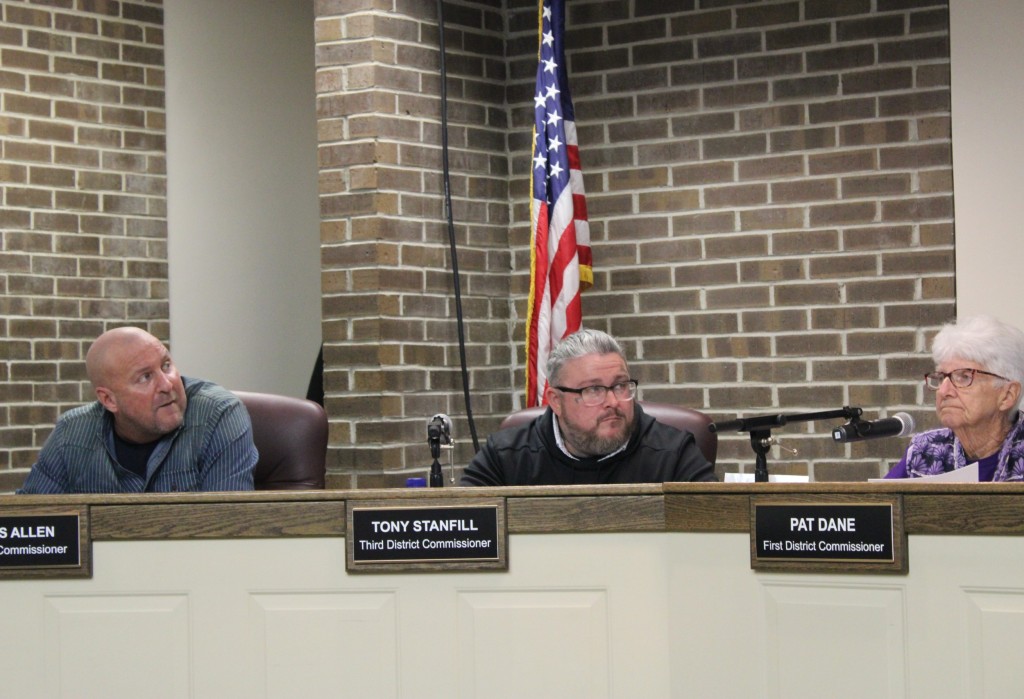
The Three Rivers City Commission met Tuesday, April 7, with a full agenda that included nearly $3 million in road and infrastructure projects, as well as about $207,000 in payments to contractors who assisted with tornado cleanup.
Watershed Voice live-streams all Three Rivers city commission meetings, including Tuesday’s, which is available to watch on its YouTube channel.
Infrastructure spending
The most expensive agenda item was the Pealer Street and Sixth Avenue reconstruction project, totaling about $2.28 million. Commissioners awarded $2,015,306 to Northern Construction Services Corp. for construction and $262,000 to Fleis & VandenBrink for construction engineering.
The project came in over its originally budgeted amount. Director of Public Services Amy Roth said the increase was largely due to expanded scope after identifying storm sewer needs during project development.
The most contentious agenda item was the Department of Public Services parking lot replacement project, where Commissioner Lucas Allen sharply questioned the city’s decision not to select the lowest bidder.
“I notice a lot of times over the last couple years, the lowest and most responsible bidder isn’t always what we peg on,” Allen said, arguing the city could save roughly $20,000 by choosing the lower bid. “Why do we even bid if the low-ball person doesn’t win?”
Allen also expressed frustration with the condition of local roads, saying, “I’m pretty sure everyone in here can say the roads are still trash.”
The exchange underscored broader tensions over cost, contractor selection, and the quality of infrastructure work across the city.
Commissioners ultimately approved a roughly $90,000 contract with Lakeland Asphalt in a 6-1 vote, with Allen as the lone dissenting vote.
Another major infrastructure item was a citywide micro-surfacing and crack-filling project totaling about $596,000. Only one bid was received, from Pavement Maintenance Systems, and commissioners approved the project unanimously.
During discussion, Roth said the city plans to present a six-year road repair plan as part of the FY 2027 budget process, with initial discussion scheduled for May 12.
Tornado response spending
Commissioners also approved about $207,000 in payments to contractors who assisted with emergency cleanup following the March 6 tornado.
City officials said the work was authorized as an emergency and not originally budgeted, requiring the use of fund balances.
Officials also indicated the city may be eligible for state reimbursement, though no confirmation has been received and the process could take several months.
Flock cameras discussion
In the latter part of the meeting, commissioners engaged in an extended discussion with Police Chief Scott Boling about the city’s use of Flock license plate reader cameras, reflecting growing concern among both officials and residents.
As previously reported by Watershed Voice, the city operates seven license plate reader cameras, which it began using in 2023 through a federal grant before taking on an annual cost of about $21,000 to maintain the system.
Boling said the cameras have assisted in a wide range of investigations, including stolen vehicles, missing persons cases, assaults, and drug-related offenses, describing the system as a “force multiplier” for the department.
The system captures images of vehicles as they pass and allows officers to search that data when investigating a crime. During the meeting, Boling said officers must select from a dropdown menu of roughly 50 crime categories and enter a case number before accessing the system.
That structure, while intended as a safeguard, drew questions from commissioners about how access is controlled and whether the system could be misused.
Mayor Angel Johnston emphasized that her concerns were not with local officers, but with the technology itself — particularly how data is stored, shared, and accessed beyond the city’s control.
Commissioner Tony Stanfill said he heard from multiple residents about the cameras, and read from a list of questions submitted to him, many focused on privacy and data security. During public comment resident Mikel Yingling submitted a written statement outlining concerns about the system, and provided sources to support his position.
The system is part of a rapidly expanding national network. Data compiled by the group Deflock shows more than 87,000 Flock cameras operating across the United States.
Civil liberties organizations, including the American Civil Liberties Union, have raised similar concerns. In a 2025 report, the ACLU warned that Flock is “building a dangerous nationwide mass-surveillance infrastructure” by allowing law enforcement agencies to access and search a shared database of vehicle movements.
The report also cited cases in which agencies used the system to conduct searches tied to federal immigration enforcement and to track individuals across state lines, raising questions about how the technology could be used beyond its stated purpose.
Boling said the department has safeguards in place, including limiting access to law enforcement and auditing searches, and said there is no evidence the system has been hacked or improperly accessed locally.
Because the system connects to broader law enforcement databases, searches associated with federal warrants — such as entries in the National Crime Information Center (NCIC) — can extend beyond a single department’s system and reach data across multiple connected networks.
Maxwell Knauer is a staff writer for Watershed Voice.
Author

Related Articles

Save the date: Watershed Voice Artist Showcase
The sixth annual Watershed Voice Artist Showcase, a celebration of local musicians, spoken word artists, and local journalism, will return to The Huss Project this summer in Three Rivers.

Celebrating our sixth birthday and Local News Day
Watershed Voice officially launched six years ago on this day in 2020, providing a combined 3,400 stories, columns, podcasts, poems and the like to residents of St. Joseph, Kalamazoo, and Cass Counties over the last 2,191 days.
Help us celebrate our birthday with a donation, and sign up for our free newsletter in observance of Local News Day on April 9.
Local meeting primer: Three Rivers City Commission
The Three Rivers City Commission will meet Tuesday, April 7, at 6 p.m. at City Hall for its regular business meeting. Commissioners will consider several new business items, including scheduling meeting dates for FY 2027 budget discussions and a public hearing, approving tornado response invoices to local contractors, and considering nearly $3 million in infrastructure projects throughout the city.
The meeting will be livestreamed on Watershed Voice’s Facebook page and uploaded to YouTube afterward.
