
Journalists discuss AI, bias, and the future of local media during Southwest Michigan Journalism Collaborative panel
The panel featured five journalists, each representing a different outlet within the collaborative, of which Watershed Voice is a member: Gordon Evans of WMUK, Lem Montero of Public Media Network, Aya Miller of MLive, Kathy Jennings of Second Wave Media, and Reed Williams of NowKalamazoo.
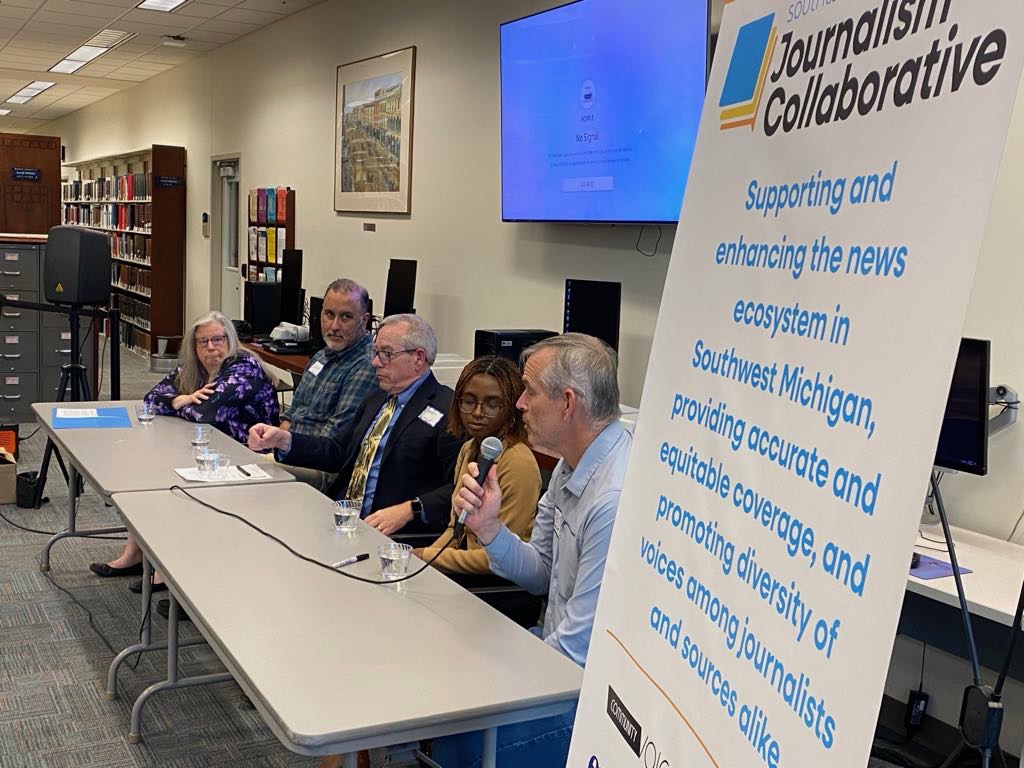
Journalists from across Southwest Michigan gathered on Thursday, October 16 to discuss artificial intelligence, evolving media, bias, and more during the Southwest Michigan Journalism Collaborative’s “Meet the Media” panel.
The panel featured five journalists, each representing a different outlet within the collaborative, of which Watershed Voice is a member: Gordon Evans of WMUK, Lem Montero of Public Media Network, Aya Miller of MLive, Kathy Jennings of Second Wave Media, and Reed Williams of NowKalamazoo.
The event invited community members to meet local journalists, ask questions, and share what they value in local news coverage.
What is the Southwest Michigan Journalism Collaborative?
The Southwest Michigan Journalism Collaborative (SMJC) is a partnership of news organizations and community partners working to strengthen local journalism and address information needs across the region. Formed in 2019 with support from the Solutions Journalism Network, the collaborative focuses on solutions-based, community-centered reporting.
“As our work continued over the past six years, we recognized that together, we can be greater than the sum of our parts,” Jennings said, noting the collective’s combined reach of about 295,894 readers across print and digital platforms.
Community Q&A
The event was structured as a community question-and-answer session, with audience questions guiding discussion among the panelists.
An early question focused on artificial intelligence and how journalists are adapting to its growing presence in the newsroom.
Miller, the youngest panelist, shared that MLive is exploring ways to improve newsroom efficiency through AI. She mentioned a tool called Editor’s Eye that provides advanced spelling and grammar checks for completed stories.
Miller added that MLive has also experimented with feeding previously published stories into AI programs to generate refreshed versions with new takeaways. Each version is reviewed against the original reporting to ensure accuracy before publication and includes an AI-use disclosure.
Evans and Williams reported only minimal use of AI, primarily for proofreading and formatting. Montero said Public Media Network occasionally uses AI to generate summaries of city government meetings.
Williams said NowKalamazoo is open to using AI for logistical or administrative tasks such as spreadsheet organization or copy editing but not as a reporting tool.
Evolving media platforms
Panelists also discussed how journalists are adapting to changing media habits and platforms.
Miller described MLive’s use of short-form TikTok videos to deliver quick news updates. Montero said Public Media Network has seen success with vertical, informal-looking videos that perform well on social media.
Williams broadened the discussion to the evolving definition of journalism, noting how influencers are increasingly viewed as journalists by some audiences.
“Really it comes down to: Is it useful? Have we made your lives better? Have we made you feel more capable, more safe, or more connected to your community?” Williams said.
Miller added that impact is central to her work, emphasizing how storytelling can meaningfully affect people’s lives.
On bias and transparency
One of the final questions focused on bias and whether journalists should publicly disclose their personal beliefs.
Evans cautioned that “once you release those biases, you can never undo that.”
Miller and Williams said bias is inevitable but manageable through fairness and awareness. Miller, who identified herself as a Black woman, said she strives to set aside personal identity when reporting — an often difficult task when faced with racist or sexist comments during interviews.
“There’s always three sides to a story; yours, mine, and the truth,” she said, echoing a common journalistic adage.
An audience member asked about the lack of television news representatives at the event. Co-organizer Kathy Jennings explained that local TV outlets were invited but declined to attend. “We did invite WOOD TV8 and Channel 3, but they didn’t show up,” Jennings said. Neither are part of the collaborative.
Learn more
Community members can learn more about or support the collaborative’s commitment to local journalism here.
Maxwell Knauer is a staff writer for Watershed Voice.
Author
Related Articles
Kalamazoo commissioners seek broader oversight of surveillance technology
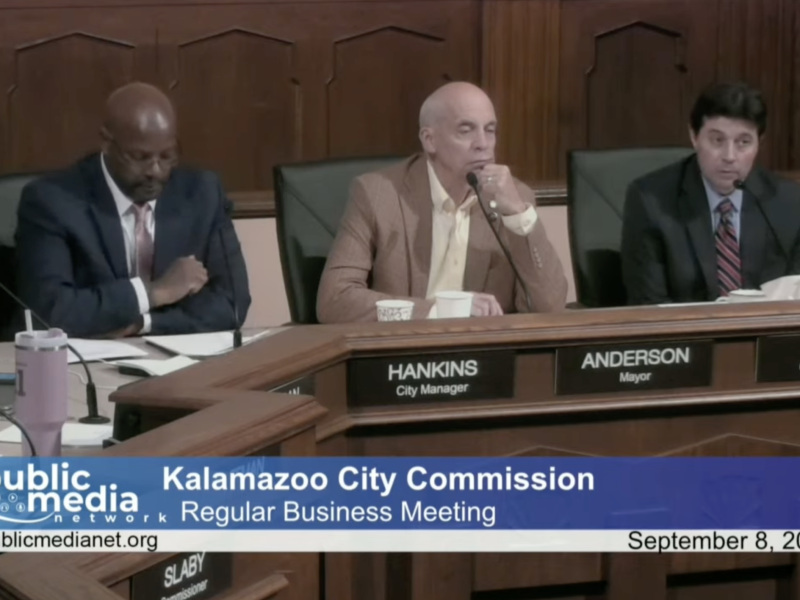
During the Kalamazoo City Commission meeting on Tuesday, September 8, commissioners decided to delay the formal adoption of a policy that would require contracts involving automated license plate reader technology to come before the City Commission, regardless of cost.
Vice Mayor Drew Duncan proposed expanding the amendment, asking that the policy incorporate all law enforcement surveillance technology, not just license plate readers.

Kalamazoo to consider data center ‘task force’ alongside moratorium
Planning commissioners unanimously recommended the data center moratorium zoning amendment, along with the task force recommendation, to the City Commission. The task force idea came up during public comment when resident Katie Bloom, who said she also serves on the city’s Environmental Concerns Committee, expressed support for the moratorium and called for a task force representing a wide range of stakeholders. Commissioners agreed with Bloom and added the amendment to their recommendation.
A different kind of house music
This Saturday in Kalamazoo roughly a dozen performers and bands will play mini-concerts around the Vine neighborhood during a five-hour Vine Porch Crawl.
The plan is to start at 2 p.m. at the Vine Neighborhood Association (806 S. Westnedge Ave.) with a set by Persian Rugg to kick off the neighborhood tour. For the full lineup and locations, read this article.
