
After nearly seven-hour meeting, Kalamazoo City Commission votes to preserve Asylum Lake
Residents spoke for nearly three hours during the public hearing portion of agenda, with nearly every speaker voicing opposition to the rezoning.
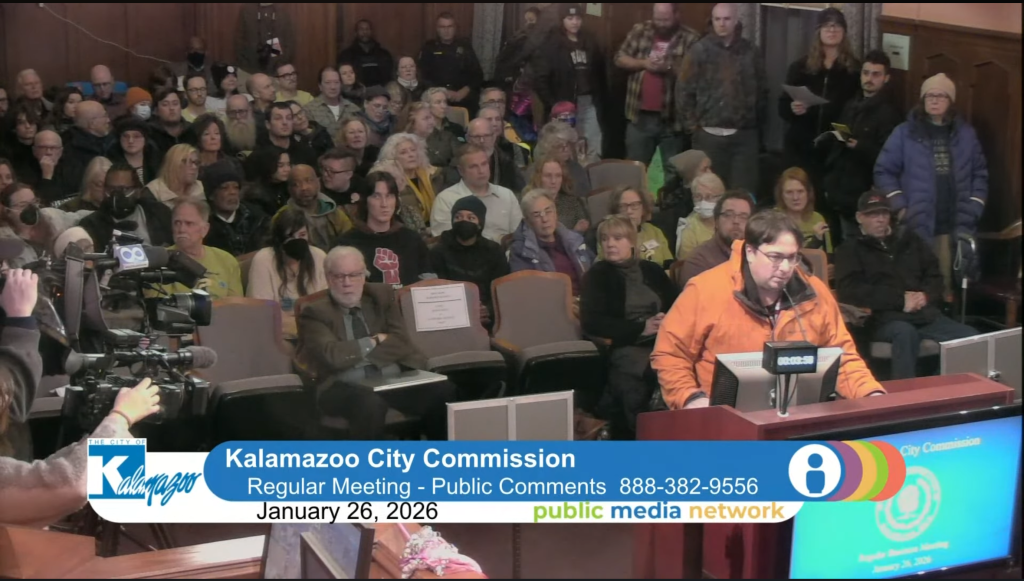
After nearly seven hours of discussion, public comment and deliberation, the Kalamazoo City Commission voted unanimously late Monday night to deny a rezoning request for a controversial property bordering the Asylum Lake Preserve.
The commission met Monday, January 26, for its long-awaited meeting to consider a request to rezone the 18.8-acre property at 4301 Stadium Dr. from RM-15 and RS-5 residential zoning to CC, or Community Commercial. The parcel is subject to the city’s Natural Features Protection Overlay and sits directly adjacent to the Asylum Lake Preserve.
The meeting was held in a tightly packed City Hall chamber, despite residents’ requests for a larger venue and city staff efforts ahead of time to identify alternative locations to accommodate expected crowds.
Residents spoke for nearly three hours during the public hearing portion of agenda item F.1, with nearly every speaker voicing opposition to the rezoning.
Prior to public comment, Mayor David Anderson clarified that this was technically the first time this specific rezoning request had come before the City Commission.
“This issue has never been to the Kalamazoo City Commission before… this is the first time that this zoning request has been to the Kalamazoo Commission,” Anderson said, responding to residents who expressed frustration at repeatedly having to defend the preserve.
While the issue of development near Asylum Lake has surfaced multiple times over the years, city records show that a 2020 rezoning request did not advance to the City Commission after an unfavorable Planning Commission recommendation when the applicant requested the case be stopped. A separate application in 2023 was withdrawn before reaching the Planning Commission public hearing stage.
Before resident comments began, attorney Emily Palacios, representing the property owners, presented the request from the applicant’s perspective.
“This request is not about getting a car wash approved, we’ve listened to the community over a several year period in trying to evaluate what the site could be used for and what the right combination of zoning and approvals would be,” Palacios said, in part.
The proposal was previously reviewed by the Planning Commission during a November 6 meeting, which unanimously recommended against the rezoning following a public hearing. Since the planning commission is only a recommending body, the item still advanced to the City Commission for consideration at last night’s meeting.
Nearly three hours into the meeting, residents began offering comments directly on the Asylum Lake agenda item.
“I think it was a bad bet, more homework should’ve been done,” one resident said, pointing to vacant buildings throughout the city and downtown that they argued would be a better fit for the property owners’ development goals.
Other residents emphasized why they value the land, citing its ecological importance, beauty, and proximity to Asylum Lake.
“What the community needs is protected green spaces. We have a river downtown that’s buried more than it’s beautified, and we have a rare preserve of Asylum Lake, and we have to come up here every couple months and argue that it’s worth defending,” Western Michigan University student Tate Wierda said.
“Preventing contamination is far more cost effective than attempting to reverse it,” another resident said.
Resident feedback focused on ecological concerns related to development near the preserve, urging commissioners to listen to the hundreds of residents gathered in opposition, and included personal accounts describing how the nature preserve has shaped individuals’ connection to Kalamazoo.
The issue has spanned years, as the property owners have repeatedly sought rezoning that would allow more intensive commercial uses on the land. Each attempt has drawn extensive public opposition when brought before city planning bodies.
Due to the unusually large turnout, city staff implemented overflow rooms within City Hall, accepted phone-in public comments and used a ticketing system to manage speakers. About 150 residents signed up to speak, according to Assistant City Planner Bobby Durkee and Mayor Anderson, with Durkee calling speakers forward by ticket number as their turn came.
After all residents were able to comment, commissioners began their own discussion of the rezoning request.
Commissioner Jae Slaby opened the dialogue by clearly outlining her opposition.
“Given the sensitivity of this location and the longstanding community emphasis on protecting natural assets it is prudent not to lock in the highest level commercial intensity here ahead of that broader Imagine Kalamazoo 2035 planning effort,” Slaby said. “Taken together, I do not find that this rezoning meets the required criteria and I cannot support the request at this time.”
Commission discussion continued for roughly 45 minutes before commissioners voted unanimously around 1:20 a.m. to reject the rezoning request. The decision drew relief and applause from the remaining audience members nearly seven hours after the meeting began.
General public comment and ICE pushback
In addition to the rezoning hearing, residents also spoke for nearly two hours during the general public comment portion of the meeting.
Several residents referenced the recent fatal shootings of two people in Minneapolis involving federal immigration agents and called on the commission to take a formal stance against Immigration and Customs Enforcement. Speakers also urged city officials to guarantee that the Kalamazoo Department of Public Safety will not cooperate with federal immigration enforcement if agents come to Kalamazoo.
One of the residents’ demands was for the city to remove Flock Safety automated license plate reader (ALPR) cameras and to opt out of KDPS’ contract with the company.
As Watershed Voice previously reported, a Texas sheriff’s office conducted a nationwide search through Flock’s network of more than 83,000 cameras in 2023, with the reason listed in search logs as “had an abortion, search for female.” Authorities publicly described the effort as a welfare or missing-person check, but records later released in response to public records requests described it instead as a “death investigation” related to a self-managed abortion.
Residents Monday night cited the case as an example of how the technology could be used to surveil vulnerable populations and track people across jurisdictions.
“There is not a camera use that our public safety uses that allows access by anyone other than those at the department and they are not under any circumstances allowing immigration services to access our cameras,” City Manager Malcolm Hankins said in response to residents’ concerns.
KDPS has previously said it uses license plate reader technology to capture and store vehicle plate data and images for a limited period unless they become part of an active investigation, and that it does not share data with federal immigration enforcement agencies.
Maxwell Knauer is a staff writer for Watershed Voice.
Author

Related Articles

Southwest Michigan Journalism Collaborative to host “Women in Media” event in Kalamazoo
The Southwest Michigan Journalism Collaborative (SWMJC) will host “Women in Media: Behind the Headlines” on April 16 from 5:30 to 7 p.m. at the Epic Center in downtown Kalamazoo.
The free event, which is open to the public, will feature a panel of local women working in journalism and media. Space is limited, and RSVPs are recommended.
Racist policies shaped a neighborhood. Its lone banking institution helps people overcome
The Northside is one of Kalamazoo’s poorest neighborhoods. It’s also 83% Black.
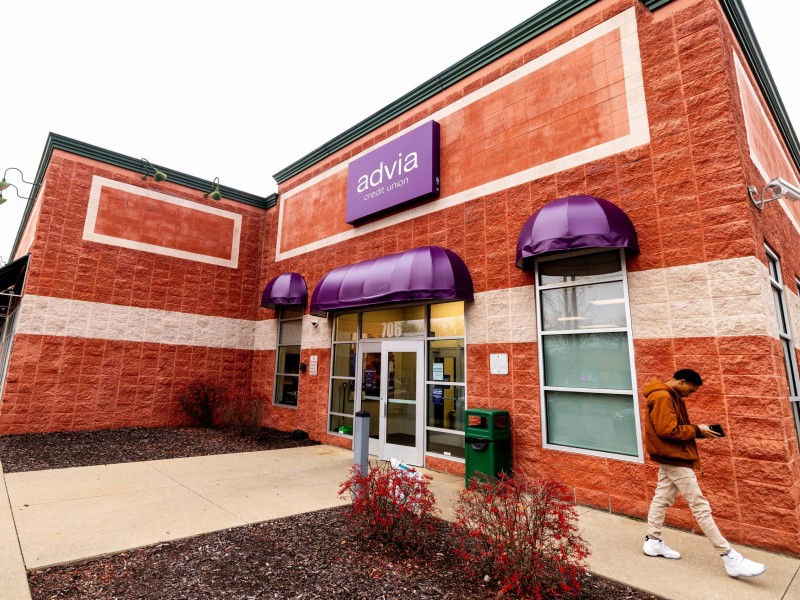
But the neighborhood of 4,500 residents has just one banking institution: Advia Credit Union at 706 N. Westnedge Ave.
It’s carrying the load to help Northside residents build financial security.
Portage moves toward data center pause as concerns grow nationwide
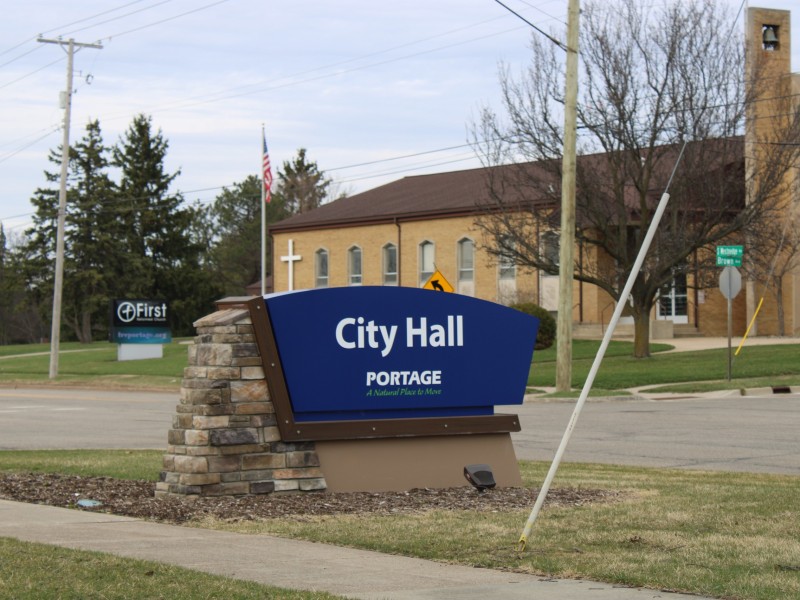
The Portage City Council on March 24 unanimously voted to move forward with an ordinance that would establish a temporary moratorium on data centers and battery energy storage systems (BESS).
The action does not immediately enact the moratorium. Instead, it directs city staff to prepare an amendment to the city code for future council consideration.
According to the meeting agenda, the proposed change would amend Chapter 42 of the city code to establish a temporary moratorium on the developments.
If adopted at a future meeting, the moratorium would pause new development related to data centers and battery storage systems while the city considers how to regulate them.
