
Q&A: Ann Burch with Indivisible-Paw Paw
Through “local action, civic engagement, and collective advocacy,” Indivisible-Paw Paw (formerly Indivisible Southwest Michigan), stands “together against authoritarianism, to defend voting rights, and to hold our leaders accountable,” according to its website.
Watershed Voice recently interviewed Ann Burch, a member in leadership with Indivisible-Paw Paw, a “nonpartisan group who believes in American democracy, governed by the three branches of our country, upheld by the Constitution.”
The group’s website states, “We are a grassroots community united in the fight to protect and strengthen our democracy. We believe in building a just, inclusive, and representative government — one that truly reflects the voices of the people. Through local action, civic engagement, and collective advocacy, we stand together against authoritarianism, to defend voting rights, and to hold our leaders accountable.”
This interview was conducted via email and has been edited for length and clarity.
Deborah Haak-Frost: Tell us a little bit about yourself and what prompted you to get involved with Indivisible-Paw Paw.
Ann Burch: I am a retired public relations/market coordinator for a community college. Before that I was a trainer and educator for a non-profit government contractor, as well as a newspaper journalist. I am a member of the Indivisible-Paw Paw Steering Committee and am the team leader for the communications and research teams. I have been a member since [the] first meeting in November.
Like many people, I was conflicted after the election. This wasn’t about my person losing the election and the other guy winning. It felt deeper and darker than that. I have grandchildren and I find it hard to explain why the president of our country bullies and demeans others; how that has become acceptable behavior. I feel our country has normalized presidential corruption.
As a former journalist, I am always for the truth. I look for the facts. I am very concerned about the false narrative this administration is pushing, rewriting history, and protecting our basic right of freedom of speech. I see this right slipping away.
DHF: How did Indivisible-Paw Paw come about, and how has it grown since it started?
AB: Indivisible-Paw Paw (formerly Indivisible Southwest Michigan) recently changed our name to reflect how other groups have referred to us. We’ve grown in both support and recognition from the surrounding communities.
Our group formed after the 2024 election. Fifteen people gathered in a private home to share their reaction to the election. Some ranted and some cried, but mostly there was talk about what could be done. From the sharing of ideas, the consensus was to make our voices heard. The group decided to meet in January, taking a holiday break in December.
On a very cold, snowy January day, 40 people attended that meeting. The momentum was growing. It was apparent the February meeting would have to be moved if the numbers continued to increase. As it was, there were 60 people at the February meeting held at a restaurant.
By March, our group joined the national and state Indivisible organizations. Currently, we have more than 300 members. As a young group, we are finding our footing, which includes joining with other groups in Southwest Michigan supporting their protest efforts. These include Indivisible groups in South Haven, Saugatuck/Douglas, Kalamazoo/Portage, and St. Joseph/Benton Harbor, as well as numerous national organizations that are participating in phone calls and postcard writing events.
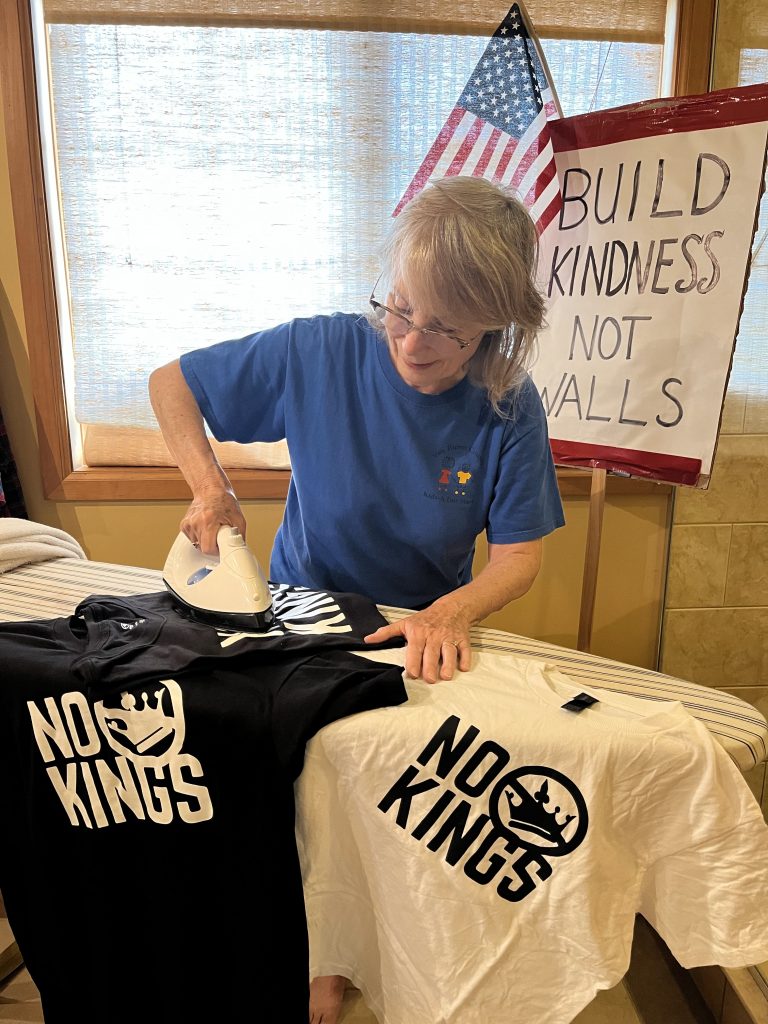
Our organization has a steering committee who strategizes and coordinates several sub-committees. We have an events team, a communications, social media, and marketing team, a creative team who make posters, banners, t-shirts, and flags, a research team who plows through the endless flow of information, and a safety team.
DHF: What kind of events does Indivisible-Paw Paw put on?
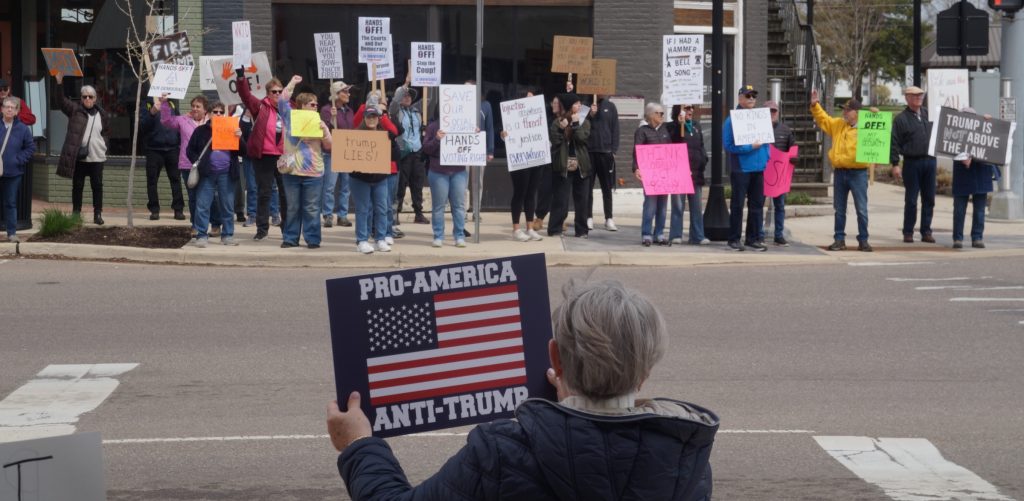
AB: We organize two weekly protests at the Portage office of U.S. 4th District Representative Bill Huizenga. These are held in conjunction with Indivisible of Greater Kalamazoo each Wednesday (12-1:30 p.m.) and Friday (4:30-6 p.m.).
Huizenga, like his Republican colleagues, has refused to hold town halls in his district, citing that many of the protestors are “paid agitators.” He doesn’t take phone calls, citing the calls were clogging phone access for those who have “real problems.” His website directs constituents to fill out an online form verifying their addresses [and declining those outside his district].
Our first event was during the nationwide April 5 “Hands-Off” protest, where we had approximately 300 people who listened to speakers and marched to downtown Paw Paw. We’ve held three protests in downtown Paw Paw since, each having a significant showing of support. All protests have been peaceful, and we have taken steps to ensure that by having trained and easily-recognized team members staged among the protestors. We have the support of the Paw Paw Police Department as well.
DHF: The group has collected donations for local organizations in connection with the protests. What other community connections have you made?
AB: Indivisible-Paw Paw strongly believes in giving back to the communities from which many of us live. (We are not all from Paw Paw). Through our events, we’ve collected and donated more than $1,100 to food pantries in Southwest Michigan. Food pantries have taken a big hit with the loss of funding from the U.S. Deptartment of Agriculture through the Feeding America program. Every community in Van Buren County has a food pantry, so our efforts will continue to focus on the pantries.
Indivisible-Paw Paw will participate in the nationwide “No Kings” protest this Saturday, June 14 from 10 a.m. to 12 p.m. We will be collecting donations for the Bangor Summer Migrant Program’s school pantry/clothes closet that serves area summer migrant families and students.
DHF: What would you say to someone who doesn’t think protest or civic engagement is important or effective?
AB: I would tell someone who has doubts about the effectiveness of protesting that history has shown that they do work. We have a long history of labor movements in this country, i.e. unions, safer work conditions, child labor laws; civil rights protests; and the Vietnam protests of the 60s. […] Women have long fought for the right to own property, the right to vote, and the right to decide what happens to our own bodies. Protests do work.
But probably the most significant protest I can think of is the day we decided to break away from England and declare we would no longer be governed by a king!
Deborah Haak-Frost is the Caretaker for Community Engagement at GilChrist Retreat Center in Three Rivers, and volunteers with *culture is not optional, a Three Rivers-based community development organization.
Author
Related Articles
2026 Primary Election results part 2: El-Sayed wins Democratic Senate nomination, incumbent Steve Carra advances
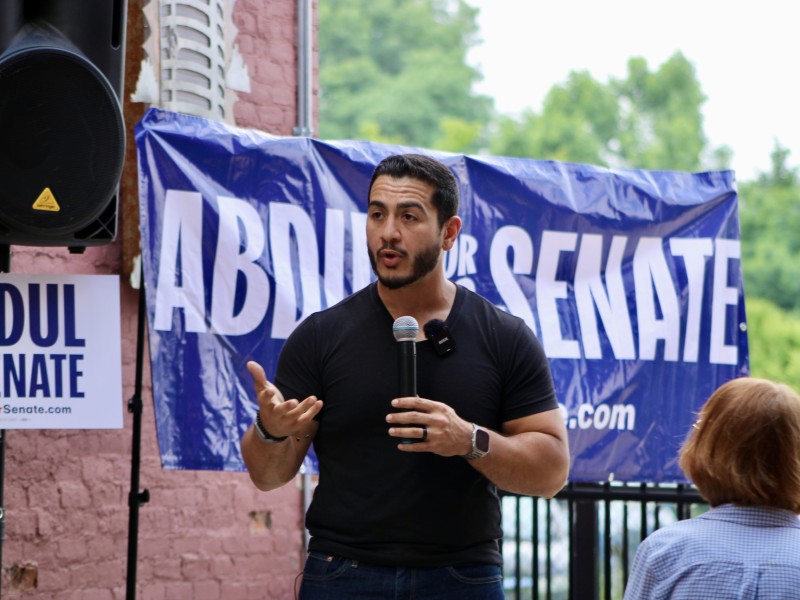
El-Sayed narrowly won the Democratic nomination, receiving 48.48% of the vote (740,950 votes), while Stevens received 47.51% (726,057 votes). Former candidate Mallory McMorrow, who withdrew from the race in early July, still received more than 50,000 votes. While some votes are still being counted across the state, the Associated Press has called the race for El-Sayed.
2026 Primary Election results: Haigh, Hoeppner advance in Three Rivers second district commissioner race
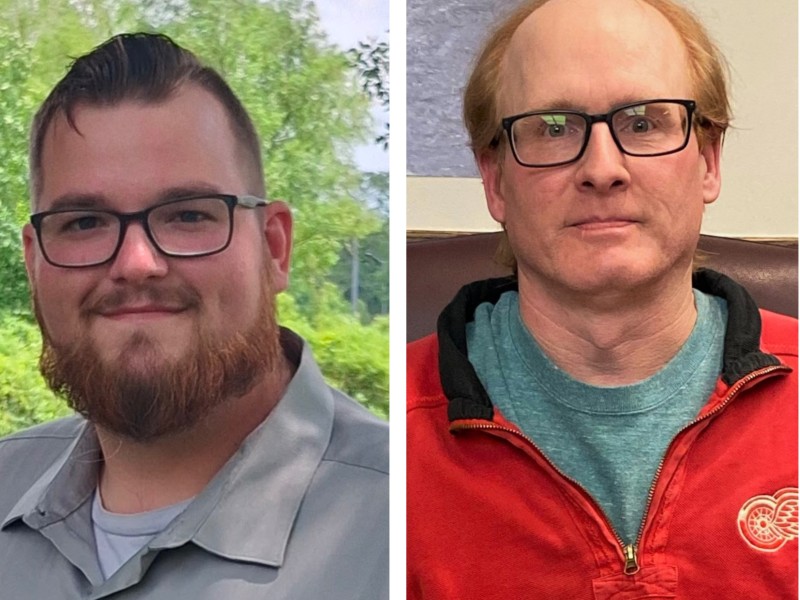
In the Three Rivers City Commission Second District primary, Josh Hoeppner received the most votes, receiving 43.29% of the vote (410 votes). Incumbent Steven Haigh finished second, with 33.79% of the vote (320 votes). The two advance to November’s general election, where they will face-off head-to-head.
Three Rivers Commission begins Habitat for Humanity project, receives update on ‘Biggby lot’
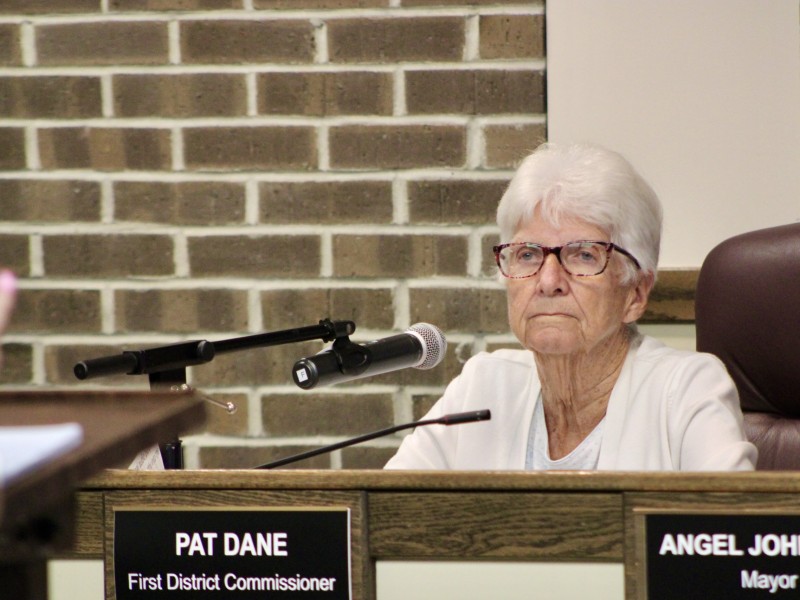
City Attorney TJ Reed provided commissioners with an update on the long-running enforcement case involving the parking lot at 209 U.S. 131, commonly known as “the Biggby lot.”
Reed said the process could take at least six months because the city’s enforcement options must proceed through the courts.
