
Lockport residents raise alarms as battery storage rules advance
Zoning Administrator Douglas Kuhlman said Lockport Township is ultimately limited in whether it can allow or block Battery Energy Storage Systems projects. Kuhlman added that the township needs its own ordinance to simply retain any say in future development, and urged residents to contact their state lawmakers about the issue.

“If you really don’t want [Battery Energy Storage Systems], you need to contact your state reps,” Zoning Administrator Douglas Kuhlman said before a public hearing Thursday on a proposed text amendment. The amendment would give Lockport Township authority to regulate battery storage.
Kuhlman began the Lockport Township Planning Commission meeting by telling residents the township is ultimately limited in whether it can allow or block BESS projects. He explained since the state passed Public Act 233 in 2023 — a law that allows developers of large-scale renewable energy or storage projects to seek a certificate from the Michigan Public Service Commission (MPSC) and preempts local zoning unless the township has adopted a “compatible renewable energy ordinance” no more restrictive than the state’s standards — the township could lose jurisdiction over siting decisions.
Under PA 233, utility-scale wind, solar, and energy storage facilities above certain capacity thresholds (≥100 MW for wind, ≥50 MW for solar, and ≥50 MW/200 MWh for storage) must follow a siting process at the MPSC under certain circumstances. The law defines a compatible renewable energy ordinance (CREO) as one that allows the development of such facilities, and whose requirements are “no more restrictive than those set forth in section 226(8)” of the act.
“No more restrictive” was a key point discussed by Kuhlman, who said the township needs its own ordinance to retain any say in future development. If a proposed facility meets those state standards but a local government rejects it, or imposes additional requirements after declaring a CREO, the developer may apply to the MPSC, which can override local rules.
“Somebody in Lansing is going to look at a map of Lockport Township and say, ‘Wow, these are cornfields in the country. Sure, those farm fields can be solar panels.’ So they’re not going to care what you think,’” Kuhlman said.
Kuhlman and Planning Commission Chairperson Sherri Nowicki urged residents to contact their state lawmakers to push for repeal of Public Act 233.
The commission expressed agreement with many residents’ concerns, and stressed that the text amendment is intended to give the Township at least some input, rather than leaving all decisions to Lansing.
Nowicki also spoke about the time she has invested in the issue. “We have done our due diligence and we’re trying to be as careful and respectful to the land of Lockport Township as we can be. We are not taking this lightly.
“I don’t dedicate all these hours to this township for no reason. I bust my ass for this township. So when you [residents] say ‘I don’t like this battery,’ I don’t like it either. I don’t have a choice. The State of Michigan and the legislature put us in this position,” she said.
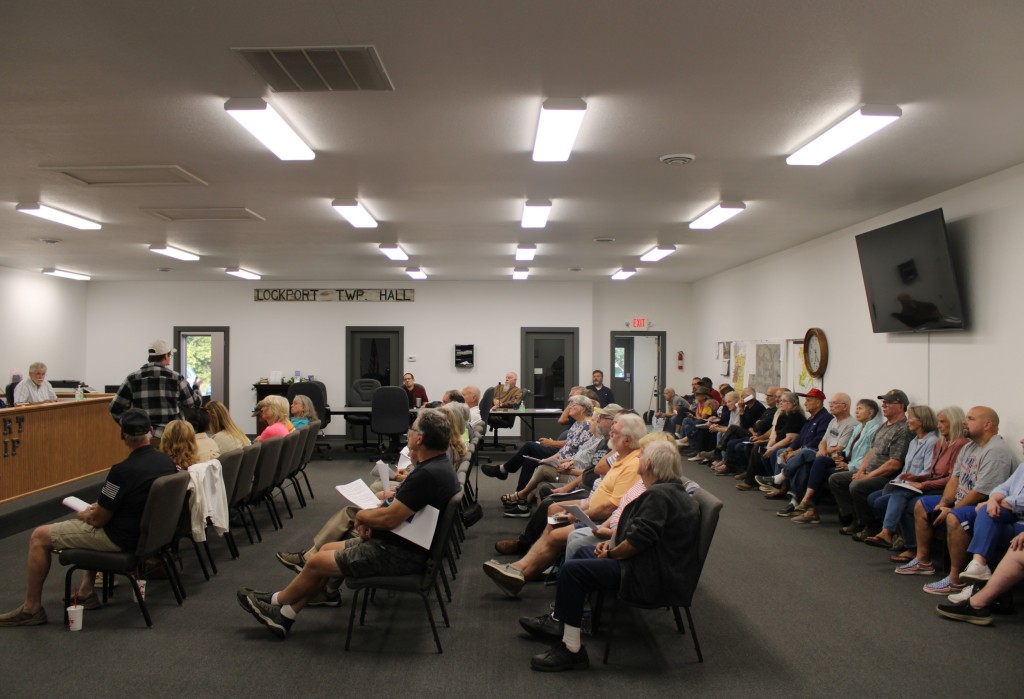
Nowicki also noted the record attendance for a planning commission meeting, saying she’s never had this many residents in attendance.
What is a BESS?
A Battery Energy Storage System (BESS) is defined in the draft ordinance as one or more devices, assembled together, capable of storing excess energy from a solar energy system for use at a future time. In practice, a BESS facility can consist of multiple container-sized battery units connected to the electric grid.
Supporters view BESS as a way to make renewable energy more reliable regardless of weather or demand cycles, while critics worry about fire safety, hazardous materials, and the industrial footprint of such projects in rural areas.
Resident comments
Residents raised concerns about environmental impacts, water supply, ground contamination, difficult-to-contain fires, hazardous gas leaks, and township transparency.
Many urged the commission to consider alternative sites, citing the solar overlay district adopted last year and its proximity to Fishers Lake, the Portage River, and the St. Joseph River. Nowicki responded that the overlay district was chosen because it lies between the township’s substations, which are the grid connection points where solar or storage projects feed electricity into the system.
“South Fisher Lake Road, come south to Airport Road, to M-60 to Haynes Road. That is the least dense area of residential properties,” said Nowicki. “That was strictly the most reasonable place to put it, to be in between all of our substations.”
While discussing alternative sites, Nowicki also expressed concern about annexation of Lockport land by the City of Three Rivers. “If the city would quit annexing all of our property, we would probably have some left,” she said.
What if a developer does come?
As it currently stands, if a developer proposed a 100-megawatt BESS, they could bypass Lockport Township entirely and apply directly to the MPSC for a siting certificate under PA 233. The township would have little authority unless it had a compatible ordinance in place. Ultimately, the property owner would still decide whether to lease their land for such a facility.
If the proposed text amendment is adopted, Lockport would at least have BESS regulations on the books. The draft ordinance requires fencing, NFPA-compliant safety signage, emergency response plans, stormwater runoff management, and decommissioning procedures. Township officials note this would not prevent developers from going through Lansing, but it would allow Lockport to apply its own safety and siting standards if a project came before the local board.
The commission distributed contact information for State Senator Jonathan Lindsey (R), State Representative Steve Carra (R), and the Michigan Townships Association.
The commission unanimously passed a motion to recommend the proposed text amendment to the township board of trustees. Chairperson Sherri Nowicki, Louella Hamilton, Mike Friesner, Charlane Zavala, Kelli Atkinson, Kelly Belshaw, and Charles Ross all cast votes in favor of the motion.
Maxwell Knauer is a staff writer for Watershed Voice.
Author

Related Articles

Michigan Nurses Association sues Sturgis Hospital over closure notice
The Michigan Nurses Association (MNA) has filed a federal lawsuit against the recently closed Sturgis Hospital, alleging the hospital violated the federal Worker Adjustment and Retraining Notification (WARN) Act by failing to provide the required advance notice before laying off employees. The law generally requires employers to provide 60 days’ advance notice of certain plant closings and mass layoffs to affected employees or their union representative.
In a statement shared with Watershed Voice, MNA said nurses only received 72 hours’ notice, violating the federal 60-day requirement.

Watershed Voice sends out candidate questionnaires for August primary election
This Thursday, July 16, Watershed Voice sent out candidate questionnaires to candidates in the following August primary elections: State Senate District 17, State House District 36, and Three Rivers City Commission 2nd District.
Candidates in those elections will have exactly one week, until Thursday, July 23 to complete the questionnaires. Once completed, Watershed Voice will publish the responses in the order they are received the week before the August 4 election.

Glen Oaks welcomes first CDL-A class in Sturgis
Based in Sturgis, the accelerated three-week program combines classroom instruction with behind-the-wheel training, giving students the skills needed to earn a CDL-A license and begin careers in commercial trucking. The program is offered through a partnership between Glen Oaks Community College and Regen Trucking School.
