
Flock cameras dominate Kalamazoo public comment as commission approves housing items
Supporters described the cameras as a public safety tool that can help solve crimes and locate suspects. Opponents argued the system raises civil liberties concerns, and could contribute to broader surveillance networks with limited public oversight.
Roughly 15 residents spoke in favor of continuing the program, while about 10 residents spoke against it.
While public attention centered on Flock cameras, the commission also approved several agenda items involving housing, infrastructure, and economic development.

The Kalamazoo City Commission met Monday, April 20 for a regular business meeting where public comment was dominated by debate over the city’s use of Flock license plate reader cameras.
Although no agenda item related to the cameras was scheduled for discussion or action, commission chambers were crowded with residents, clergy members, and community leaders speaking both in favor of and against the technology.
Flock Safety cameras are automated license plate reader systems that capture vehicle images, license plate numbers, time stamps and location data. Police departments use the technology to search for vehicles connected to crimes, missing persons cases or investigations. Critics argue the systems can enable mass surveillance, create privacy risks and allow data-sharing beyond local control, while supporters say they are a valuable investigative tool. Watershed Voice previously reported on the technology’s use and surrounding concerns in Three Rivers.
Supporters described the cameras as a public safety tool that can help solve crimes and locate suspects. Opponents argued the system raises civil liberties concerns, and could contribute to broader surveillance networks with limited public oversight.
In what appeared to be a coordinated showing, several faith leaders, neighborhood voices, and community advocates spoke in support of the cameras.
Wendy Fields, president of the Kalamazoo branch of the National Association for the Advancement of Colored People (NAACP), said representatives of her organization recently met with the Kalamazoo Department of Public Safety to learn more about how the cameras operate and their intended benefits.
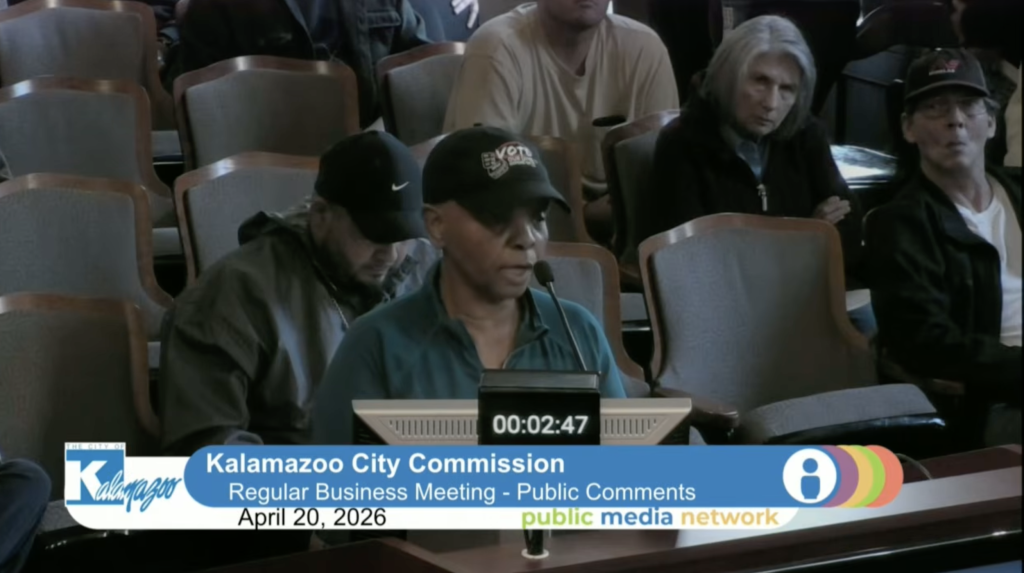
Fields said the organization supports the city’s use of the technology as a crime-fighting tool.
Several supporters referenced two fatal shootings in Kalamazoo over the weekend, arguing the city should continue using every available resource to address violence.
Daniel Cunningham of Pastors on Patrol urged commissioners to continue backing the program.
“I ask that this 56th city commission continues to support the uphill battle for this work that we do. Let us be that beacon of light. Let us be that community that sets the example with the support of Flock as a tool in our arsenal in our community,” Cunningham said.
Another supporter, Gregory Jennings, also with Pastors on Patrol, said the cameras provide added assistance to police.
“I hope and pray that we continue to use Flock because it is doing something that the naked eye cannot do, and in a city where crime is happening a lot we need to have all the advantages that we can,” Jennings said.
Multiple supporters also argued the city is not sharing data with federal immigration authorities, responding to concerns raised by critics.
Roughly 15 residents spoke in favor of continuing the program, while about 10 residents spoke against it.
Opponents said the technology risks over-policing communities and diverts attention from deeper causes of violence such as housing instability, poverty and inequity.
One resident, Kay, said the city should invest in root-cause solutions rather than additional surveillance.
“If we continue to use policing as a band-aid, to say this is what we have now, then we’re never going to imagine something better than that. We’re never going to imagine communities that actually don’t need to be policed, just need resources, just need equity,” she said.
Other residents called on the city to provide more public education about the system and hold informational sessions where residents could ask questions.
Commissioner Jae Slaby was the only commissioner to directly address the issue during the meeting. Slaby encouraged residents to review the city’s online FAQ page, and said additional public conversation could help residents better understand the technology.
While public comment lasted more than an hour and a half, commissioners did not otherwise debate the issue during the formal meeting.
Housing and development items approved
While public attention centered on Flock cameras, the commission also approved several agenda items involving housing, infrastructure, and economic development.
Commissioners approved the city’s 2026 HUD Action Plan, which outlines how Kalamazoo plans to use more than $2.8 million in Community Development Block Grant and HOME funds for housing and neighborhood programs. Planned uses include homeowner repairs, rental and security deposit assistance, youth homelessness services, legal aid, neighborhood improvements and code enforcement. The plan includes $400,000 for housing inspections and code enforcement activities. Slaby, Mayor David Anderson and Jeanne Praedel abstained. Vice Mayor Don Cooney Duncan, Chris Wilson, Jeanne Hess and Stephanie Hoffman voted in favor.
The commission also unanimously approved the consent agenda, which included street repair contracts, water system upgrades, dam engineering work, board and commission appointments, and utility easements tied to the Kalamazoo Event Center project.
On the regular agenda, commissioners unanimously approved the sale of 808 Simpson St. to Kalamazoo Neighborhood Housing Services for $500, along with a related budget amendment.
They unanimously authorized the Brownfield Redevelopment Authority to accept a $1 million grant from the Michigan Department of Environment, Great Lakes, and Energy in support of the Kalrecovery Housing Project, along with a matching budget amendment.
The commission later entered closed session to discuss labor negotiations and returned to unanimously approve a collective bargaining agreement with the Kalamazoo Municipal Employees Association, which represents city employees in multiple departments.
Maxwell Knauer is a staff writer for Watershed Voice.
Author

Related Articles
Kalamazoo commissioners seek broader oversight of surveillance technology
During the Kalamazoo City Commission meeting on Tuesday, September 8, commissioners decided to delay the formal adoption of a policy that would require contracts involving automated license plate reader technology to come before the City Commission, regardless of cost.
Vice Mayor Drew Duncan proposed expanding the amendment, asking that the policy incorporate all law enforcement surveillance technology, not just license plate readers.

Kalamazoo to consider data center ‘task force’ alongside moratorium
Planning commissioners unanimously recommended the data center moratorium zoning amendment, along with the task force recommendation, to the City Commission. The task force idea came up during public comment when resident Katie Bloom, who said she also serves on the city’s Environmental Concerns Committee, expressed support for the moratorium and called for a task force representing a wide range of stakeholders. Commissioners agreed with Bloom and added the amendment to their recommendation.

A different kind of house music
This Saturday in Kalamazoo roughly a dozen performers and bands will play mini-concerts around the Vine neighborhood during a five-hour Vine Porch Crawl.
The plan is to start at 2 p.m. at the Vine Neighborhood Association (806 S. Westnedge Ave.) with a set by Persian Rugg to kick off the neighborhood tour. For the full lineup and locations, read this article.
