
Three Rivers approves splash pad plan funding; continues SAFEbuilt discussions
SAFEbuilt came up repeatedly throughout the meeting, with commissioners raising their own and residents’ complaints about the company and SAFEbuilt representatives responding.
The discussion began during public comment when Glenn Lindsay, SAFEbuilt’s Midwest director of operations, addressed what he said were social media posts regarding the amount the city pays SAFEbuilt. Lindsay sought to explain the expenditures and argued that revenue from permits and rental inspections offsets much of the cost of SAFEbuilt’s services.
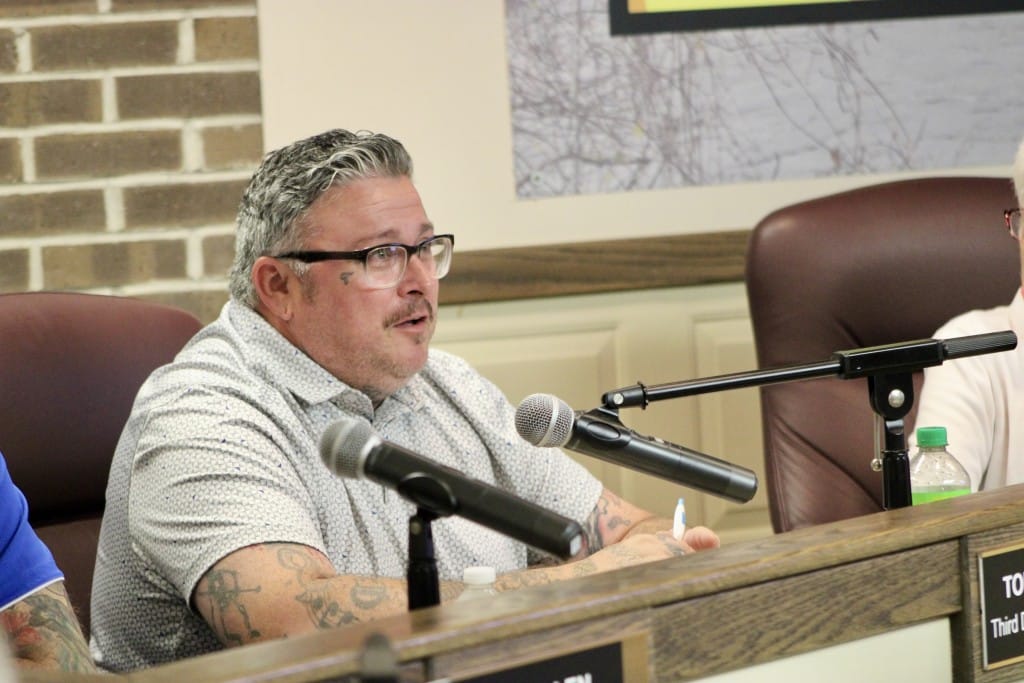
The Three Rivers City Commission met Tuesday, September 15, approving funding for a splash pad conceptual fund and the transfer of a city-owned lot to Habitat for Humanity, while continuing discussion about SAFEbuilt’s services in the city.
SAFEbuilt
SAFEbuilt came up repeatedly throughout the meeting, with commissioners raising their own and residents’ complaints about the company and SAFEbuilt representatives responding.
The discussion began during public comment when Glenn Lindsay, SAFEbuilt’s Midwest director of operations, addressed what he said were social media posts regarding the amount the city pays SAFEbuilt. Lindsay sought to explain the expenditures and argued that revenue from permits and rental inspections offsets much of the cost of SAFEbuilt’s services.
“It was brought to my attention that there are some claims out there about the amount of money or the size of the checks that are being written to SAFEbuilt,” Lindsay said. “So I wanted to clarify with you all.”
Lindsay said SAFEbuilt receives 90% of the city’s permit fees, with the remaining 10% staying with the city. He said rental inspection fees similarly fund those services, while code enforcement is billed separately to the city.
According to the figures Lindsay presented, the city recorded net gains of about $2,300 in 2021 and $13,000 in 2022 before recording net costs of about $25,000 in 2023, $31,000 in 2024, and $12,000 in 2025. He said the city recorded a roughly $19,000 net gain in 2026. Lindsay attributed much of the costs beginning in 2023 to about $22,000 annually for proactive code enforcement.
Lindsay’s comments prompted discussion from commissioners who have previously criticized SAFEbuilt, including Mayor Angel Johnston, who has said SAFEbuilt inspectors did not adequately inspect work on her roof, deck, and electrical system.
During a July 7 meeting, SAFEbuilt representatives gave a presentation as commissioners considered whether to continue contracting for inspection services or bring the work in-house. Commissioners ultimately continued with SAFEbuilt giving them a “second chance,” but discussion of the company’s services has continued.
Commissioner Anthony Stanfill said he had recently received a complaint from a Third District constituent who told him a SAFEbuilt employee said the number of permits issued for a particular type of work in the city was “none of his business.” Stanfill responded that, as a resident, the information was his business.
Lindsay asked Stanfill for more information and said he would investigate the complaint.
Lindsay argued that outsourcing inspections shields the city from fluctuations in permit activity because SAFEbuilt, rather than the city, maintains the inspection staff. Lindsay pointed to increased permit activity as a year in which revenue exceeded the city’s SAFEbuilt expenditures. Johnston noted that much of the increased activity followed the spring tornado and objected to describing it as a positive year.
“In the down years, when revenue is down from permits, you then have to consider who do we lay off? Who do we let go?” Lindsay said. “The liability of the ebbs and flows in construction sticks with that private entity.”
No action was taken. Johnston returned to the issue later in the meeting during commissioner comments.
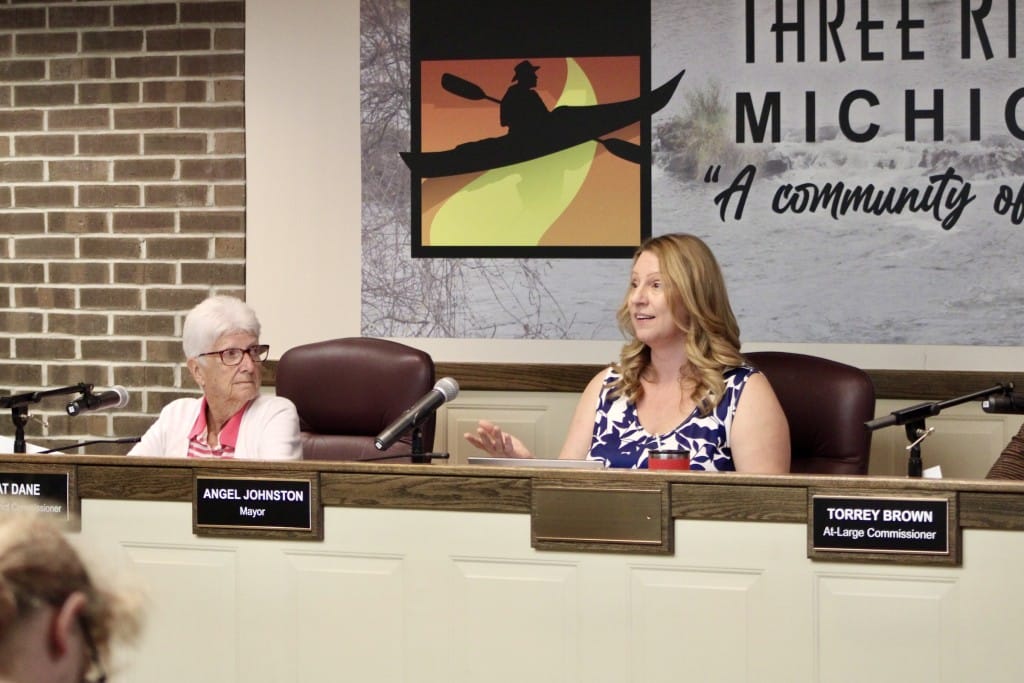
“I think what’s happening right now is justification,” Johnston said after Lindsay was explaining that inspectors typically know exactly what they’re looking for which is why some inspections, like hers, are completed within minutes.
“It’s transparency, Mayor,” Lindsay said. “You’re raising issues, and I’m being transparent with you to let you know there’s more to the story than what is being just thrown out to the public.”
Johnston said she wanted to hear residents’ experiences with SAFEbuilt.
“I’d be interested to hear what the public has to say about that,” Johnston said. “I don’t feel meaningful inspections took place.”
As for the argument that the services should remain outsourced, Johnston said she was sympathetic to it but wished the city “got good services.”
Splash pad
Commissioners unanimously approved a $24,503 contract with Fleis & VandenBrink for an updated five-year parks and recreation plan and a conceptual splash pad plan.
Of the $24,503 total, $11,236 is for the splash pad conceptual plan and visualization, while $13,267 is for the parks and recreation plan. The city had budgeted $21,000 for the project and will use $3,503 from the general fund balance to cover the additional cost.
Public Services Director Amy Roth said the city has not selected a location for the splash pad but knows it will need access to water and sanitary sewer connections.
“I don’t have the ideal site,” Roth said. “That’s why we’re bringing on professionals to work through the rest of the exercise.”
Habitat for Humanity
Commissioners unanimously approved the transfer of a city-owned lot at the southwest corner of Madison Place and Madison Street to Habitat for Humanity of St. Joseph County. The nonprofit plans to begin construction of a new single-family home in partnership with the St. Joseph County Career and Technical Education Building Trades program. Students in the program will gain hands-on construction experience by helping build the home. Construction is expected to begin this month. Habitat’s family-selection process is expected to begin in February or March 2027.
Maxwell Knauer is a staff writer for Watershed Voice.
Author

Related Articles
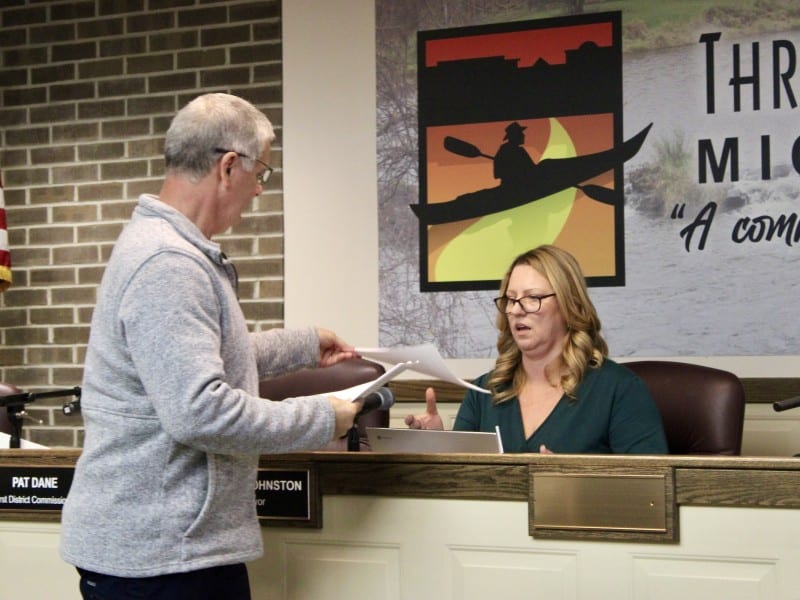
Three Rivers City Manager Joe Bippus retiring in 2027
Longtime Three Rivers City Manager Joe Bippus announced his impending retirement during Tuesday’s Three Rivers City Commission meeting. Bippus, who accepted the position in 2000, said his 27-year tenure will end effective January 14, 2027.
Watershed Voice spoke with Mayor Angel Johnston and former Mayor Tom Lowry about Bippus’ decision, and what it means for the City of Three Rivers going forward.
Local meeting primer: Three Rivers City Commission
The Three Rivers City Commission will meet this Tuesday, October 6 at 6 p.m. for a regular business meeting. Commissioners will work through a four item agenda at their first meeting since September 15. On the agenda is sidewalk replacement funding totaling $100K, airport runway obstruction removal for $1,300, a $77,500 purchase to replace and paint the chlorine hoist, and $12,667 for a change to aluminum doors at the Wellfield generator project.
Commissioners will also continue their process of purchasing and installing livestreaming equipment.
Three Rivers Athletic Club to host ribbon cutting ceremony Friday
The fitness center once thought to be closing for good will host a ribbon-cutting ceremony Friday after its new owners reopened the gym under a new name, Three Rivers Athletic Club.
