
Carra covers new Business Tax Credit bill, federal tariffs, Michigan universities’ compliance with executive orders, and more in monthly town hall
Rep. Steve Carra also discussed House Bill 4186, which he co-sponsored, aiming to amend the Michigan Business Tax Act. The bill, awaiting Senate approval, proposes raising the Michigan Business Tax rate to 30% starting in 2025.
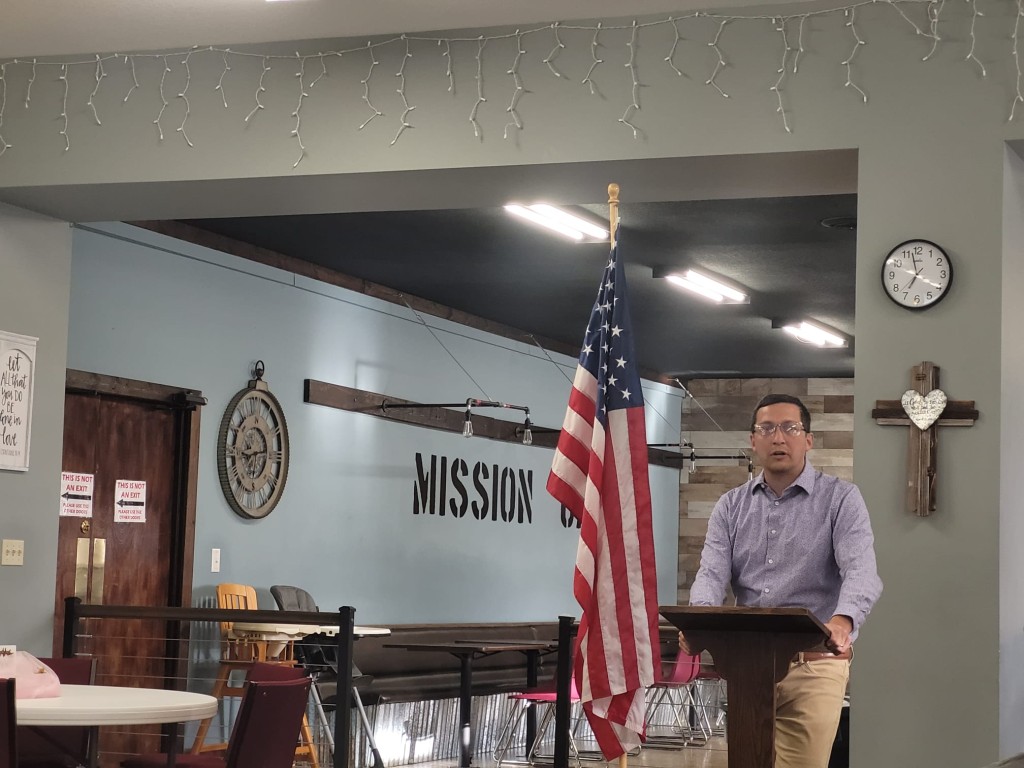
Rep. Steve Carra, R-Sturgis, addressed several key issues during his monthly townhall meeting at the Christian Fellowship Church in Sturgis on Monday, including tax reform, federal tariffs, Michigan universities’ compliance with executive orders, and local infrastructure.
Carra discussed federal tariffs imposed by the Trump administration, describing them as a way to address unfair trade practices by making imported goods more expensive, thereby encouraging consumers to buy domestic products. He argued the U.S. has long relied on trade deficits and consumption beyond its means, which he described as “an injustice to the rest of the world.”
“The United States has been privileged to have the reserve currency of the world,” Carra said. “For over 50 years, we’ve consumed more than we’ve produced, which means others have had to work harder to subsidize our consumption. This isn’t fair to the global community.”
While tariffs have faced criticism and led to reciprocal tariffs from other nations, Carra believes they could help retain wealth within the U.S., particularly benefiting the working and middle classes by supporting local businesses and reducing reliance on foreign nations and large corporations.
According to a report from BBC, many economists expect tariffs to raise prices across a range of imported goods, with many businesses expected to pass the extra expense onto consumers. Businesses may also decide to import fewer foreign goods, which could make those that are available more expensive. Goods manufactured in the U.S. that use foreign components may also rise in price:
“For example, car parts typically cross the US, Mexican and Canadian borders multiple times before a vehicle is completely assembled. Car prices had already been expected to increase as a result of earlier tariffs, which remain in place. The cost of a car made using parts from Mexico and Canada alone could rise by $4,000-$10,000 (£3,035 – £7,588) depending on the vehicle, according to analysts at the Anderson Economic Group.”
“What are tariffs and why is Trump using them?” by Jennifer Clarke, BBC
Michigan Business Tax Act, mega credits & public comments
Carra also discussed House Bill 4186, which he co-sponsored, aiming to amend the Michigan Business Tax Act. The bill, awaiting Senate approval, proposes raising the Michigan Business Tax rate to 30% starting in 2025. It would allow businesses with long-standing tax credits to switch to a new Corporate Income Tax system while maintaining their existing credits. The bill includes provisions for affordable housing projects and other credit holders.
In addition, Carra highlighted the impact of Michigan’s “mega credits” program, which provides tax incentives to businesses to retain jobs in the state. However, these credits, which date back to the 1990s, have led to a budget shortfall between $400 million and $500 million in Michigan’s $82 billion state budget, according to Carra. He noted these funds could be better used to lower taxes for everyone or fund vital public services.
“These credits are a half-billion dollars that could go toward lowering taxes or funding public services,” Carra said. “It’s time to reassess this program.”
During the town hall, Sturgis resident Dray Perkins questioned whether the bill truly benefited working-class people, accusing Carra of offering corporate welfare. Carra responded that the bill would provide tax relief across the board, lowering taxes for everyone, but acknowledged that balancing tax cuts with public service funding remains a challenge.
“If we lower taxes across the board, it helps the working class,” Carra said. “The wealthy may see a larger benefit, but it’s about providing tax relief for everyone.”
The business tax bill is part of a broader “Road Funding Package,” which includes nine bills aimed at increasing funding for Michigan’s road repairs. Carra said the state’s transportation budget would see a 50% increase, from $6.6 billion to $9.9 billion, with some of the additional funds coming from reallocating money currently spent on corporate tax credits.
Responding to concerns about uncompleted road projects in Three Rivers, Carra emphasized that the increased road funding would prioritize local improvements. “We’re using existing funds, like the money from corporate tax credits, to fund the roads,” Carra said.
Another member of the audience, Carl W. Merkh, raised concerns about President Trump’s executive orders on issues such as transgender participation in sports and the ban on critical race theory in schools. Carra expressed support for the executive orders, criticizing Michigan State University for not complying with them, while acknowledging that such issues should ultimately be addressed through legislation rather than executive orders.
On the topic of transgender athletes, Carra emphasized that boys should not compete in girls’ sports. “Lying should not be allowed,” Carra said. “Boys should not be competing against girls in girls’ sports. This is about fairness and protecting women’s rights to compete in their own category.”
It should be noted that research indicates trans people perform similarly to their cisgender competitors, and there is no statistical evidence to support the notion that trans athletes have an athletic advantage over their cisgender peers:
“The disproportionate focus on the relatively small portion of the population who are trans seems based on the belief that cis men, who cannot succeed in sports among other cis men, would choose to misidentify as trans women to gain an advantage in sports against cis women. However, there are no legitimate cases of this occurring. An individual’s sex does not determine their success or failure at any athletic event despite the high level of competition. This can be demonstrated when looking at not average outcomes, but the level of overlap among outcomes. The exclusion of trans individuals also insults the skill and athleticism of both cis and trans athletes.”
D.J. Oberlin, Department of Exercise Sciences and Recreation, City University of New York, Lehman College, Bronx, NY, United States
Najifa Farhat is a staff reporter with Watershed Voice. Executive Editor Alek Haak-Frost contributed to this report.
Author

Related Articles
May 5 Election results: Voters weigh in on school bonds, a trash ordinance, and commissioner terms
Kalamazoo County voters considered several school funding proposals, along with the high-profile Portage single-hauler trash ordinance proposal, which generated significant public debate ahead of Election Day.
The proposal would require waste haulers to register and publish fee schedules while prohibiting the city from creating an exclusive single-hauler trash contract. The measure failed with 44.73% of the vote in favor (5,381 votes) and 55.27% opposed (6,649 votes).

Voters reject Sturgis Public Schools $98.4 million bond proposal
Voters rejected the $98.475 million proposal with 54% voting no (1,501 votes) and 46% voting yes (1,277 votes). A total of 2,778 votes were cast on the proposal.
Superintendent Arthur Ebert says the district will now need to reevaluate how — or whether — many of the projects it had planned to pursue will move forward.
“All of the projects contained within the bond proposal will either need to find an alternative funding source, be reduced in scope with an alternative funding source, or not be completed.”

Disaster support hotline available for those recovering from March tornadoes
Through a $400,000 Community Development Block Grant administered by Cass County, the three-county region including Cass, Branch, and St. Joseph counties, has partnered with After the Storm to provide long-term disaster recovery support. The program will deliver comprehensive, client-centered disaster case management services to individuals and families recovering from the storm.
