
Good Grief. The Mother Wound, Part Two
Watershed Voice columnist Aundrea Sayrie’s new series “Good Grief.” explores how loss lives in everyday lives, and its impact on mental health.
In The Mother Wound, Part Two, Sayrie looks at the “absence you can’t name,” as some grief isn’t about losing someone but rather “never fully having had them in the way you needed.”
Good Grief. is a dedicated space to explore how loss lives in our everyday lives and its impact on mental health. Written through the lens of lived experience, it examines the quiet ways grief shows up. In our bodies, our relationships, and the patterns we carry. Creating space for awareness, honesty, and repurposing pain.
If you haven’t read part one of The Mother Wound series, click here.
The Absence You Can’t Name
I didn’t call anyone “mom” until I was eight years old.
Some grief isn’t about losing someone.
It’s about never fully having had them in the way you needed.
Absent mothers.
Emotionally unavailable mothers.
Mothers who couldn’t meet you where you were.
By age six, I was very aware that I was navigating the world on my own.
A foster child one home, then another.
A new school, then another.
New church.
New friends.
New caseworker.
So many new spaces…
but never really gaining anything.
Only the overwhelming feeling
of so many things being left behind.
Things.
People.
Experiences.
that always seemed just out of reach.
I remember having a taste for a favorite snack
I couldn’t name or describe
for what felt like over a year.
I kept trying to explain it.
Until one day… there it was in the grocery store.
A tube of liverwurst to go with crackers.
My adoptive mom bought it.
I ate it… and I cried.
I didn’t understand it then,
but my little body was holding so much.
So much change.
So much instability.
So much that had never been processed.
I didn’t have the language to say
that what I was feeling was grief.
It just felt like emptiness.
Like longing.
There were many days
I would look out of windows
as far as I could down the road
wondering if this would be the day
someone would come back for me.
I held onto that hope
until the night of my twelfth birthday.
I don’t know why that was the age I chose.
But something in me decided…
my childhood was mostly over,
no one was coming.
And that was no point because
I loved the family I had. And they loved me back.
This kind of disconnection shaped my identity.
I was experiencing what I now understand as
ambiguous loss…
and a deep struggle with belonging.
But at the time—
I didn’t have the words for any of it.
People ask children if they’re happy.
Or sad.
Sometimes even angry.
But no one asks a child
if they are grieving.
And I was.
I just didn’t know how to say it.
So it showed up in patterns.
I became a quiet observer.
A floater between groups.
I struggled to rely on others.
Felt discomfort in needing support.
I over-functioned in relationships.
Over-gave.
Over-extended.
I carried the group projects.
Held things together.
While quietly suppressing what I needed—
in the hope of earning acceptance
and stability.
And now recognizing that—
and where it came from—
has allowed me to meet myself
with compassion.
To forgive myself.
To use my voice
when my needs aren’t being met.
I wasn’t weak before.
I was adapting.
To being six years old
in a very big world.
And if any part of this feels familiar…
you don’t have to explain it.
You don’t have to name it perfectly.
But you’re welcome to sit with it here.
Or share… if you feel ready.
Aundrea Sayrie is a writer, narrator, advocate, and the creator of Good Grief., a reflective platform exploring grief, belonging, identity, healing, and intentional living through storytelling and spoken reflection. Drawing from lived experience, community advocacy, and creative expression, her work centers emotional honesty, connection, and giving language to the experiences many people struggle to name. She truly believes the only thing worse than hurting is hurting alone and hopes to be a companion to others through their healing journey.
If you would like to support her work as an independent writer and creative, donations can be sent via Cash App: $Asayrie
Any views or opinions expressed in this column are those of the author and do not necessarily reflect the views or opinions of the Watershed Voice staff or its board of directors.
Author

Related Articles
Aundrea Sayrie: Introducing Good Grief. Creating space for awareness, honesty, and repurposing pain
Watershed Voice columnist Aundrea Sayrie is introducing a new series exploring how loss lives in everyday lives, and its impact on mental health. This month she will examine the “mother wound,” and how a month she once looked forward to feels different, forcing her to “confront the distance” between who she is and who she wants to be.
Charles Thomas: Why sleep is so Important for our health
Watershed Voice columnist Charles Thomas writes, “Why is lack of sleep such a big problem? Because sleep is critical to our health and wellbeing! While we don’t know exactly what the purpose of sleep is, there are many theories around why we humans spend a third of our lives sleeping.
“Sleep allows our bodies to heal and our tissues to be restored during a period of rest. It also helps us consolidate our memories of the day, and regulate our moods. There is research that suggests sleep helps us tolerate pain better, and it can help remove cellular garbage in the brain called amyloids, which are linked to Alzheimer’s disease.”
Celebrating our sixth birthday and Local News Day
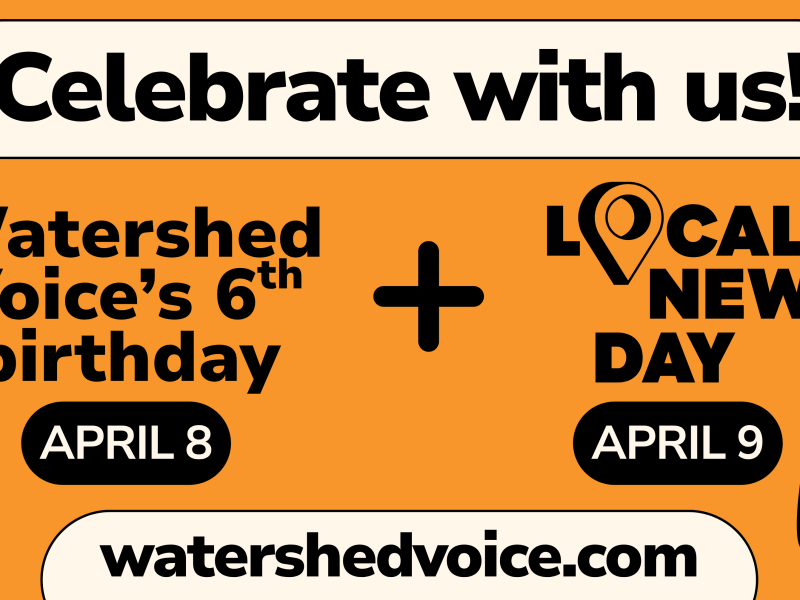
Watershed Voice officially launched six years ago on this day in 2020, providing a combined 3,400 stories, columns, podcasts, poems and the like to residents of St. Joseph, Kalamazoo, and Cass Counties over the last 2,191 days.
Help us celebrate our birthday with a donation, and sign up for our free newsletter in observance of Local News Day on April 9.
