
Kalamazoo commissioners seek broader oversight of surveillance technology
During the Kalamazoo City Commission meeting on Tuesday, September 8, commissioners decided to delay the formal adoption of a policy that would require contracts involving automated license plate reader technology to come before the City Commission, regardless of cost.
Vice Mayor Drew Duncan proposed expanding the amendment, asking that the policy incorporate all law enforcement surveillance technology, not just license plate readers.
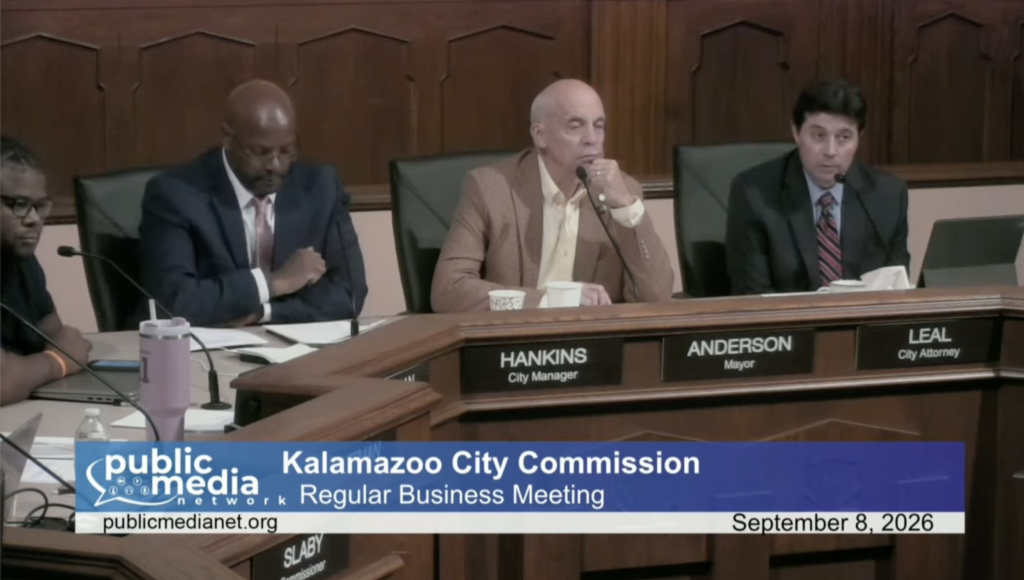
During the Kalamazoo City Commission meeting on Tuesday, September 8, commissioners decided to delay the formal adoption of a policy that would require contracts involving automated license plate reader technology to come before the City Commission, regardless of cost.
Commissioners requested City Attorney Aaron Leal and his staff develop an amendment during their August 17 meeting that would add an exception to the city’s Purchasing Policy requiring contracts involving automated license plate reader technology to be approved by the City Commission. Under the current policy the city manager can approve purchases and contracts up to $100,000, while the purchasing agent can approve those up to $50,000, with certain exceptions requiring commission approval.
The decision comes after months of residents speaking during public comment and asking commissioners to “deFlock,” or terminate the city’s contract with automated license plate reader company Flock Safety. Flock has drawn national scrutiny following reported cases involving misuse of its technology by law enforcement agencies.
While commissioners didn’t “deFlock,” commissioners instead have begun the process of requiring contracts involving the company to come before the commission. Previously, because the Flock contract fell below $100,000, it was not presented to or voted on by the City Commission.
Flock Safety operates automated license plate readers that photograph passing vehicles and make information about them searchable by law enforcement. The technology has faced growing national scrutiny over privacy, accuracy, and misuse. A Los Angeles Police Department review found 161 incorrect stolen-vehicle alerts during a two-month period, while a Washington Post investigation found at least 50 law enforcement officers had been charged with or accused of misusing Flock or other license plate reader systems, including to track former romantic partners. Flock announced additional safeguards in August intended to prevent such misuse.
During Tuesday’s meeting, however, commissioners voted to postpone the decision until September 21, allowing Leal more time to develop a revised version of the amendment. Commissioner Jae Slaby asked that the language account for the use of surveillance technology by city employees outside law enforcement, raising the possibility that other city employees could misuse the technology.
“The abuse of this technology isn’t just used to potentially be done by law enforcement. It can be done by other city staff,” Slaby said, adding that a Parks Department staff member could just as easily misuse the technology.
Vice Mayor Drew Duncan also proposed expanding the amendment, asking that the policy incorporate all law enforcement surveillance technology, not just license plate readers.
“Not only for new ALPR contracts, but any renewal, any extension, amendment, modification, expansion, replacement, or a successor vendor,” Duncan said. “I’d actually like the language to encompass all law enforcement surveillance technology.”
As discussion continued, Mayor David Anderson expressed concern with “rewriting on the dais,” warning his fellow commissioners against making substantial changes to the proposed language during the meeting. Anderson suggested they give Leal direction and have him return at the next meeting with a revised amendment, emphasizing that he did not see an immediate need to adopt it that night.
“I would be more comfortable if we expressed this and our concerns and then asked our city attorney to go back and rework this in a way and get it back out into the agenda packet before the next meeting rather than rewriting it after most people in the chambers have left,” Anderson said.
Duncan, however, disagreed and argued that commissioners should act that night, saying it’s a topic they don’t get to talk about often. Duncan said he would not rescind his motion—which included the revisions—and Commissioner Jeanne Hess then moved to postpone consideration until September 21.
That motion passed 6-1, with Duncan casting the lone no vote. Commissioners Slaby, Stephanie Hoffman, Jeanne Hess, Chris Praedel, Alonzo Wilson, and Mayor Anderson voted in favor.
Leal will take Slaby and Duncan’s requests as well as the rest of the discussion by commissioners into account before drafting a revised amendment for the next meeting.
Maxwell Knauer is a staff writer for Watershed Voice.
Author

Related Articles

Kalamazoo to consider data center ‘task force’ alongside moratorium
Planning commissioners unanimously recommended the data center moratorium zoning amendment, along with the task force recommendation, to the City Commission. The task force idea came up during public comment when resident Katie Bloom, who said she also serves on the city’s Environmental Concerns Committee, expressed support for the moratorium and called for a task force representing a wide range of stakeholders. Commissioners agreed with Bloom and added the amendment to their recommendation.

A different kind of house music
This Saturday in Kalamazoo roughly a dozen performers and bands will play mini-concerts around the Vine neighborhood during a five-hour Vine Porch Crawl.
The plan is to start at 2 p.m. at the Vine Neighborhood Association (806 S. Westnedge Ave.) with a set by Persian Rugg to kick off the neighborhood tour. For the full lineup and locations, read this article.
Kalamazoo’s inaugural Black Pride festival takes place this weekend in Bates Alley
“We’re at a special time in history where it’s important to reclaim and claim our joy and the beauty of our gathering together and basking in the creativity and ingenuity and community that we have created and that we can continue to create through an event like this,” Michelle S. Johnson, executive director and co-founder of the Institute of Public Scholarship, told Watershed Voice.
Johnson organized the inaugural event alongside Michael Cleggs-Arnott of OutFront Kalamazoo.
